Mutsuhito Meiji Quotes
The Way here set forth is indeed the teaching bequeathed by Our Imperial Ancestors, to be observed alike by Their Descendants and the subjects, infallible for all ages and true in all places. It is Our wish to lay it to heart in all reverence, in common with you, Our subjects, that we may all thus attain to the same virtue.
Meiji the Great. This quotation is an excellent example of the subtle complexities of Japanese reforms. The Emperor was doing something unheard of—sharing his teachings with all subjects so that all Japanese can equally benefit. But at the same time the subjects were not expected to consider this as advice or as a possible religious or moral way of life for them. All were expected to adopt what the Divine Emperor was sharing with them. The concept of equality advanced; individuality and freedom receded.
Mutsuhito Meiji, 1852-1912, Emperor of Japan Charter Oath, 1868
Sourced by: Eigen's Political and Historical Quotations


In his view, the ethical ideal could, but need not be a religion, but could include idealistic aspects of secular humanism or political ideal.


In 1877 Wasburn was dropped from the List of Ministers by the Unitarian Church. He had become quite atheistic.

Samuel Langhorne Clemens, 1835-1910


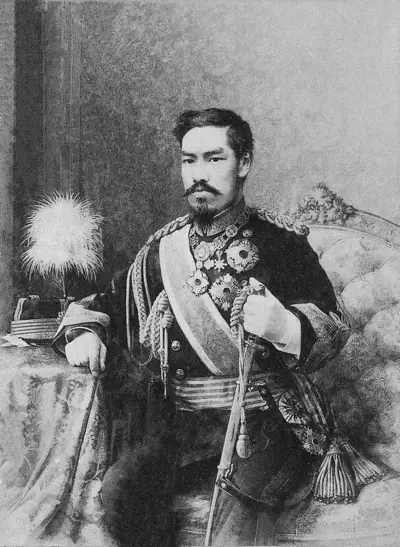
Emperor Meiji, also called Meiji the Great (明治大帝, Meiji-taitei), or Meiji the Good (明治聖帝, Meiji-seitei), was the 122nd Emperor of Japan according to the traditional order of succession, reigning from 3 February 1867 until his death on 30 July 1912, and the first monarch of the Empire of Japan. He presided over the Meiji era, a time of rapid change that witnessed Japan's transformation from an isolationist, feudal state to an industrialized world power.
