Charles B. Rangel Quotes
The War Powers Act requires presidents to seek the consent of the American people, through their representatives, before sending our troops into war. It is the responsibility of Congress to deliberate and consult with the executive branch before involving ourselves in a military conflict.
Rangel, Charles B. "Remarks on the War Powers Act." Congressional Record, Government Publishing Office.


WWII has been remembered as a “good war” which had the overwhelming support of American at the time and in historical retrospect.


In 1949 the NATO treaty was signed. There was concern that a phrase in the treaty authorizing signatories to take "such action as it deems necessary, including the use of armed force" would undermine Congress's powers:


President George W. Bush initiated an invasion of Iraq based on the fact that Iraq was developing nuclear, chemical and biological weapons. After the invasion however, there were none of these weapons found and much evidence that there were not any at that point in time. By the time Congress, the body which is supposed to declare war, found out that the reason for the war was bogus, it was too late. We had already occupied the country and were in the midst of a civil war. The President either acted on bad intelligence or wanted to invade Iraq for other reasons and history may finally tell us which, but Fein sees the problem as too much secrecy in the executive branch.


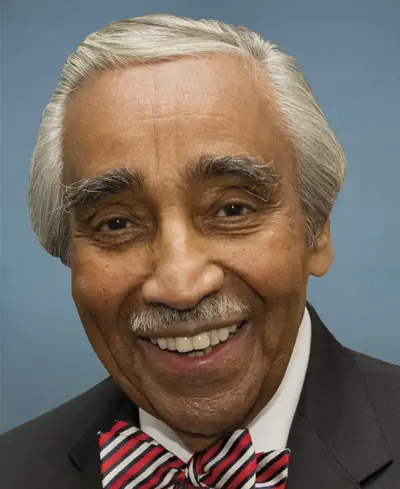
Charles Bernard Rangel is an American politician who was a U.S. representative for districts in New York from 1971 to 2017. A member of the Democratic Party, he was the second-longest serving incumbent member of the House of Representatives at the time of his retirement, serving continuously since 1971. As its most senior member, he was also the Dean of New York's congressional delegation. Rangel was the first African-American Chair of the influential House Ways and Means Committee. He is also a founding member of the Congressional Black Caucus.
