John Quincy Adams Quotes
The very first instrument for the improvement of the condition of men is knowledge.
John Quincy Adams, 1767-1848, 6th President of the United States (Independent, MA), Message to Congress, December 6, 1825
Sourced by: Eigen's Political and Historical Quotations


Husayn Ali Nuri. There are few religions where studying and learning are so valued.


1st Baron Verulam. Inscribed above the figure of Philosophy in the Jefferson Building of the Library of Congress

1st Earl of Beaconsfield


This principle characterized most Islamic cultures for the next 400 years while Christian Europe was in the Dark Ages and had ignored most of the accumulated Western knowledge of the Greeks and Romans, The Muslims however, kept this knowledge alive and added to it supporting great mathematicians, scientists, philosophers, theologians and physicians. During the 12th century extreme fundamentalists gained control over Islam and this great principle of Umar’s was not only ignored but those who acquired new knowledge were persecuted as “innovators” often a capital crime. When Christian Europe began to rise intellectually, the Muslim societies were declining. Even today, the Islamic cultures are split as to the value of new knowledge and while there are modern Muslim scholars and scientists, there are still major forces throughout Islam who consider knowledge that is not in the Koran or which contradicts the Koran not only false, but heretical, often to be punished even by death.
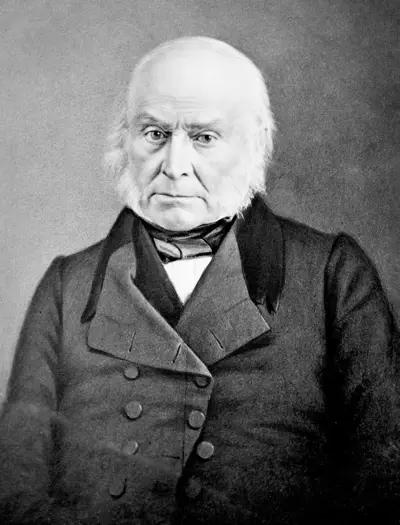
John Quincy Adams was an American statesman, diplomat, lawyer, and diarist who served as the sixth president of the United States, from 1825 to 1829. He previously served as the eighth United States Secretary of State from 1817 to 1825. During his long diplomatic and political career, Adams also served as an ambassador, and as a member of the United States Senate and House of Representatives representing Massachusetts. He was the eldest son of John Adams, who served as the second U.S. president from 1797 to 1801, and First Lady Abigail Adams. Initially a Federalist like his father, he won election to the presidency as a member of the Democratic-Republican Party, and in the mid-1830s became affiliated with the Whig Party.
