Greg Grandin Quotes
The unraveling of America's long mid-century domestic consensus, which ran from about 1941 to 1966, had begun earlier, under Lyndon B. Johnson.
Grandin, Greg. Kissinger's Shadow: The Long Reach of America's Most Controversial Statesman. Metropolitan Books, 2015.


This quotation is puzzling to many in that Olasky seems to be castigating the President because he wanted to develop a “Great Society”—because he had a great vision for America. However, to Olasky and a small core of religious fundamentalist conservatives a President wanting to develop a great society was bad for two reasons. They do not believe that the government – any government should shape the nature of the society or interfere with individuals and families in shaping society. A government that could have such a vision and implement it must be a big government which is per se undesirable. In addition, in their orthodox view God has already determined the vision for society and no man should try and substitute his vision for God’s commandments. This concern of an energetic secular government having independent vision is not only a problem for the right wing Christian fundamentalists, but is typical of Muslim fundamentalists and Jewish also. There were a small minority of Jewish Israeli fundamentalists who objected to the creation of the State of Israel at the birth of the Jewish state for the same reasons that Olasky gives for opposing a strong visionary government.


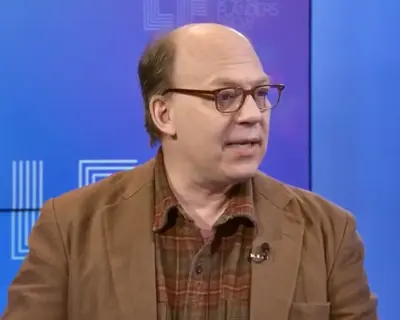
Greg Grandin (born 1962) is a professor of history at Yale University. He previously taught at New York University. He is author of a number of books, including Fordlândia: The Rise and Fall of Henry Ford's Forgotten Jungle City, which was a finalist for the Pulitzer Prize for History, as well as for the National Book Award and a National Book Critics Circle Award. A more recent book, entitled, Who Is Rigoberta Menchú?, focuses on the treatment of the Guatemalan Nobel Peace Prize winner. His 2014 book, The Empire of Necessity: Slavery, Freedom, and Deception in the New World, is a study of the factual basis for the novella Benito Cereno by Herman Melville.
