J. Edgar Hoover Quotes
The unnecessary result of wartime hysteria.
J. Edgar Hoover, 1895-1972, Director, Federal Bureau of Investigation, Description of the Japanese-American Internment in World War II, Quoted on The History Channel, America’s Time, February 26, 2000
Sourced by: Eigen's Political and Historical Quotations

Shortly after the Japanese attack on Pearl Harbor:


The Proclamation was a belated admission of the disgraceful internment of loyal Japanese Americans during WWII. See {587961}. “Evacuation” was the euphemism for rounding up Japanese American citizens and putting them in internment camps. Not a single Japanese American was involved in any effort to sabotage or undermine the United States. The same cannot be said about the German Americans where a few did work against U. S. interests and yet the German-Americans were never rounded up. The explanation of the difference has been long debated. Racism was a part of it; California paranoia, another. And unfortunately, Japanese Americans owned very desirable land in California and when they could no longer make their payments some interests gobbled up the land and that was a motivation for some. Regardless, it was one of the low points in American history, and warranted this Presidential and national apology.


This quotation shows the level of denial that De Valera and other Irish leaders were in over Nazi Germany. See {639721} for other Irish Free State denial. Over 70,000 Irishmen and women rejected the moral stand of their government, and volunteered for the British Army to the great distress of the Free State leaders like De Valera.


He was a realist who foresaw that even though the South had been militarily defeated, there were those who would persist in their efforts to retain slavery or a de facto form where freedom is the form but subjugation was the substance. It would be Jim Crowe and terrorism in the form of the KKK and a successor to Lincoln who was very sympathetic to the aims and culture of the Southern Rebels.

He was convicted for treason for passing secrets to the Germans and sentenced to life imprisonment on Devil’s Island. However, he had been the victim of an anti-Semitic plot to cover up for the real traitor—a Christian. However the ”Dreyfus Affair” brought out the virulent anti-Semitism in France. When the truth was exposed, Dreyfus was pardoned, and reinstated in the military, but 11 years in Devils Island had taken its toll on his heath, and he was retired as a result of his disability.

This quotation is surprising in that Mrs. Roosevelt was a leading liberal and one of the leading advocates for peace. This quotation might have been authored by a right wing conservative of the early 21st century.
She was very conflicted about the interment of Americans of Japanese origin. She understood the arguments for the internment and some had some merit for her. But she was opposed to the internment from the beginning. However, she frequently discussed this issue privately with FDR. She consulted with the judges who dissented in the law suits and presented their arguments to her husband. She visited some of the internment camps and maintained a correspondent with some of the interned Japanese American leaders. Earlier, once FDR signed the internment executive order, she maintained a public silence on the issue until 1944 when she publicly broke with her husband on this issue. (While that may be shocking to us today—for a first lady to publicly disagree with the President—for Mrs. Roosevelt, it was not unusual and was not the scandal that it might be today. Throughout her over 3 terms as First Lady, she wrote a daily newspaper column and did a weekly radio show for much of the period.

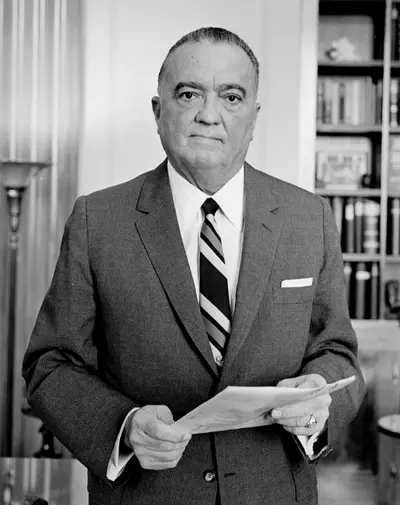
John Edgar Hoover was an American law enforcement administrator who served as the first Director of the Federal Bureau of Investigation (FBI) of the United States. He was appointed director of the Bureau of Investigation – the FBI's predecessor – in 1924 and was instrumental in founding the FBI in 1935, where he remained director for another 37 years until his death in 1972 at the age of 77. Hoover has been credited with building the FBI into a larger crime-fighting agency than it was at its inception and with instituting a number of modernizations to police technology, such as a centralized fingerprint file and forensic laboratories. Hoover is also credited with establishing and expanding a national blacklist, referred to as the FBI Index or Index List, renamed in 2001 as the Terrorist Screening Database which the FBI still compiles and manages.
