Charles Dickens Quotes
The System is rigid, strict and hopeless solitary confinement, and I believe it, in its effects, to be cruel and wrong.
See {623440} .
Charles Dickens, 1812-1890, English Writer, Comment on his visit to Eastern State Prison in Philadelphia, PA, Pictures from Italy and American Notes for General Circulation
Sourced by: Eigen's Political and Historical Quotations

This Pennsylvania prison was supposedly a “modern” reform in law enforcement. Rather than work gangs or mandatory factory work, this was the first “penitentiary” in America. The guilty convicts would be in a small cell for all but 1 hour or less a day, and the only thing in the cell other than soap and a toothbrush was a Bible. The convict was supposed to spend his sentence reading th Bible and being penitent for his crimes. It destroyed most inmates mentally until the Supreme Court Ruled total solitary confinement was unconstitutional. There are a fee high security prisons today where there is no social contact allowed the inmates and their constitutionality is being litigated based on Miller’s 1890 opinion. Another point that this quotation illustrates is that sometimes reform efforts produce a situation that was worse than before.


Russia, under the Czar, had a brutal criminal justice system where criminals—often with their families—were forced across Russia to Siberia and Sakhalin. Stalin and the Communists did not invent the Gulag concept but then, although total enemies of the Czar and everything he stood for, emulated the worst of Czarist policies to deal with the Russian “enemies” of the state. The reference to “red-nosed prison supervisors” was to the image of the alcoholism that was (and still is) rampant among so many Russians—especially the prison supervisors who themselves were exiled to the harshest and remotest parts of the nation. They were notoriously heavy drinkers even be Russian standards.


On a tour of America, Dickens visited Eastern State Penitentiary, a Pennsylvania prison opened in 1829 which was supposedly a “modern” reform in law enforcement. Rather than work gangs or mandatory factory work and filthy living conditions, this was the first “penitentiary” in America. The guilty convicts would be in a small clean but bare cell for all but 1 hour or less a day, and the only thing in the cell other than soap and a toothbrush was a Bible. The convict was supposed to spend his entire sentence reading the Bible and being penitent for his crimes. It destroyed most inmates mentally until the Supreme Court ruled in 1890 that total solitary confinement was unconstitutional.


At that time in American History, the George W. Bush Justice Department had a small team of lawyers who wrote a legal brief that defined torture in such a way that many of the most common forms of torture were no longer legal torture, even though they had been torture in American law and were again torture after this embarrassing episode of American history. The renamed techniques were called “enhanced interrogation” and a few terrorist suspects were subjected to it before the rules and laws were changed and the “legal opinions” nullified. The FBI and military intelligence did not use the so called enhanced interrogation techniques as they felt that torture produced unreliable intelligence as the victim will say anything the questioner wants to hear to end the torture. They also thought the Justice department memo was sloppy and defective legal work. Senator McCain was a particular expert on torture in that he had, during the Vietnam War, been captured and imprisoned for 7 years during which he had been tortured on several occasions.


As a Federal Judge, she was obligated to sentence people guilty of certain crimes to a minimum sentence prescribed by law and a sentencing commission.


Martin Luther King and his SCLC were demonstrating in St. Augustine, Florida against the segregation in that community. The local law enforcement officers had conspired with the local KKK groups to allow the group to beat the demonstrators and then arrest the demonstrators for disturbing the peace and demonstrating in the face of a local injunction against the demonstrations. Then the local authorities placed huge bail on the arrestees that they could not easily meet. While they were in custody, they were tortured in various ways. Judge Simpson, vacated the injunction and ordered that the demonstrators not be arrested, and if they were for any other crime reasonable bail be required. He also recommended prosecution of the wrong-doers. Remarkably, FBI Director J. Edgar Hoover ordered his agents not to protect the civil rights demonstrators on the grounds that the FBI should not provide protective services. Hoover had a personal hatred of King who he claimed was a Communist, a sex pervert, and a law breaker. The President then threatened the Florida Governor to send Federal Marshalls into St. Augustine if the state could not maintain law and order. The Governor and the Georgia Senators pleaded to stop the demonstrations which were being intensified because King and the Civil Rights Demonstrators were gaining huge sympathy with the general public as a result of the journalists’ reports and Judge Simpson’s findings. The Civil Rights Bill of 1964 was being filibustered by the Southern senators at that time and this was a tactical victory, but some of the civil rights demonstrators were paying a fearful physical price. Judge Simpson died 4 year later, hated by the KKK and other segregationists in Florida. However in time, even the local Floridians came to appreciate the Judge’s role. The graphic shows the Federal Courthouse named in Judge Simpson’s honor.
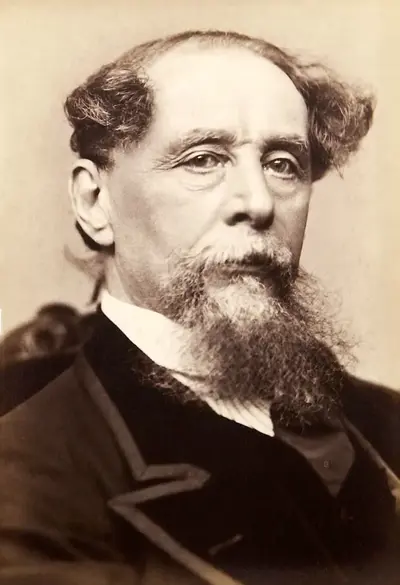
Charles John Huffam Dickens FRSA was an English writer and social critic. He created some of the world's best-known fictional characters and is regarded by many as the greatest novelist of the Victorian era. His works enjoyed unprecedented popularity during his lifetime and, by the 20th century, critics and scholars had recognised him as a literary genius. His novels and short stories are widely read today.
