Martin Heidegger Quotes
The student body of the University of Freiburg announces that it is determined to carry the fight against Jewish-Marxist undermining of Germany to the bitter end, to the complete annihilation of the foe. The public burnings of Jewish-Marxist writings on May 10, 1933, served as a symbol of this fight. Germans, rally to this fight! Make your participation public! From the publishers and bookstores send us all books and writings that deserve burning. Let each one bring what he finds, or tell us about it so that we may go get it. The fire of destruction is to us like a blazing up of the German spirit and German custom and practice.
Martin Heidegger, 1899-1976, German Philosopher, Breisgauer Zeitung, May 18, 1933
Sourced by: Eigen's Political and Historical Quotations

This is another of Heine’s predictions of Nazi Germany. The book burning was followed by the Holocaust. See {622242}.

Dodd, in Berlin from 1933 to the onset of WWII, was able to see first hand what Hitler and the Nazi Movement was really like, Although he for the United States and Churchill for England warned early on, the politics of the times would not allow any action to stop or curtail Hitler. America, in particular, had a strong isolationist Republican wing and in addition, a small but loud core of pro Fascist, Hitler admirers such as Charles Lindburg, Father Coughlin, and Henry Ford. America had virtually no serious military capacity at the time, and with the Depression, FDR had all he could do to just gradually build up the military. By the time the Democracies realized that Dodd and Churchill were right, it was too late to prevent WWII. Dodd died in 1940 just when it was clear that he had been right.

The Christian Front was one of the network of Fascist organizations established and controlled by “radio priest” Charles E. Coughlin. In 1940 investigative reporter Lawrence Spivak did an expose of the Christian Front and The FBI raided its offices and confiscated many weapons intended for the assassination of people including a dozen members of Congress. See {588482}.

There was a rumor in 1922 amongst American Fascists and extreme conservatives that Henry Ford was going to run for President. Hitler and Ford were mutual admirers. In Hitler’s diatribe, Mein Kamph, the only American he refers to with favor was Ford, whose virulent anti-Semitism was very popular in Germany.


This was one of the most hateful of his public speeches. He was one of the American “heroes” in Nazi Germany, receiving assistance from the Nazi government. Between his anti-Semitism and support for Hitler, Fascism and radical socialism, the Vatican ordered him off the air and shut down his political demagoguery.


At the time Ford was considering running for President and some of the American right wing extremists were encouraging him to do so. Hitler had demonstrated how his fascist storm troopers would intimidate a major city as he had done it first in Munich and later in most other German cities. At the time, Ford and his supporters were delighted to have the support of such an important modern world leader as Hitler. The American Nazi Party's first president, Heinz Spanknoebel, was an employee at the Ford Motor Company. Fritz Julius Kuhn, leader of the pro-Nazi German-American Bund, worked at Ford off and on. As Hitler’s practices and policies were more and more exposed, and WWII began, this quotation made any political role for Henry Ford very difficult. Ford was the only American named in Hitler’s maniacal book Mein Kampf. He describes Ford as the only American who is not controlled by Hitler’s paranoid view of the Jewish conspiracy. Ford himself was an anti-Semite. See related quotes. Hitler awarded Ford the German Eagle Order Medal—the only American to have ever received it. It was reserved for those who assisted the Nazi Party outside of Germany. Benito Mussolini was another recipient.

Germany before Hitler was a very narrow, formal, rigid, militaristic, class conscious, authoritarian, society.

After the war Donitz was found guilty of Unrestricted Submarine Warfare and using thousands of slave laborers in his shipyards. He was sentenced to 10 years, one of the lightest sentences if the German War Crimes Trials.
The allies—mostly under American Pressure—only tried the highest ranking Nazi war criminals. Many wanted to try the rest, but they did not prevail. Lord Russell, the English prosecutor at Nuremburg resigned in protest as he had case files on over 100,000 Nazi war criminals who were never prosecuted. The main object was to use those officials to establish a strong anti-Communist government in post war Germany.


In 1918 the Treaty of Versailles—peace treaty ending WWI—was signed. Many Germans felt that their defeat in WWI forced them to sign the treaty which weakened Germany and assured that they would be a 2nd rate power thereafter. After that Germans blamed every negative aspect of their government, economy and society on the treaty that was “forced” on them. Nazism was a consequence of these feelings, and the Nazis adopted policies and practices to get around their anti-military obligations and have a strong government so that the allies could not enforce the treaty obligations on Germany.

Germany had been a world intellectual center of science, arts and letters. After the Nazi’s came to power most of the great German Intellectual leaders like Albert Einstein—both Jews and non-Jews—left Germany. A few like Roth remained, but those espoused by the Nazis were second rate and the “feebelists of dilettantes.”

Dulles had little regard for the immorality of using Nazis as agents including major war criminals—even when it was against U. S. law and policy. The CIA continued to be insensitive and over the years employed some of the worst right wing murders and war criminals, The “precedent” was set after WWII by Dulles. See also {633240}.

Before there were supermarkets, different produce was sold in different stores. Grocery stores run by grocers, sold fruits, vegetables, cereals, and canned goods but not meat of fish which had their own special stores.


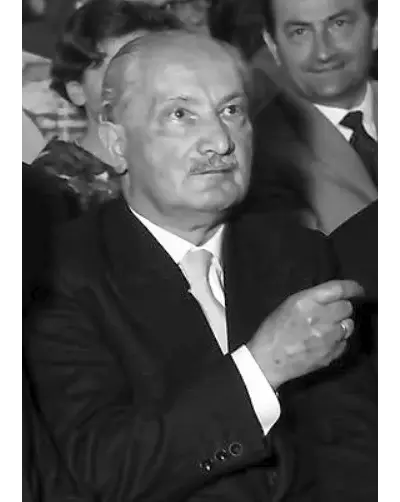
- Born: September 26, 1889
- Died: May 26, 1976
- Nationality: German
- Profession: Philosopher
Martin Heidegger was a German philosopher who is widely regarded as one of the most important philosophers of the 20th century. He is best known for contributions to phenomenology, hermeneutics, and existentialism.
