Ismail Haniyeh Quotes
The Palestinian people do not beg the world for a state, and the state can't be created through decisions and initiatives. States liberate their land first and then the political body can be established.
Haniyeh, Ismail. Public Address. 18 Sep. 2011, Gaza City.


The Kurdish People do not have a homeland of their own but are minorities of other states—mostly in Turkey and Iraq. There was a “Kurdistan” for a few years but it did not last do to major geopolitical forces. Whereas Barzani is opposed to violence, there are other Kurds who have resorted to vicious terrorism in their quest for a homeland. Kurds represent a wide range of opinion on the best way to create a stat of Kurdistan, but they were at the time, almost unanimous on their desire for independence and the belief in their moral right to have a homeland.


The Ottoman Turks, at war with Russia, exterminated a large proportion of the Armenian population of the then Turkish Empire. Some of the ethnic Armenians were working with Armenians in greater Russia and thus were a risk to the Turks. However, they starved, shot, beat, hung, and bayoneted hundreds of thousands of ethnic Armenians, wiping out entire villages and towns. Despite the fact that women and little children were all killed, Modern Turkey even into the 21st century refused to admit that this was a genocide even though there was ample documentation to prove it was not spontaneous but government ordered by the “Young Turks” then controlling Turkey. See {620603} and {612638} for examples. The modern Turks maintain the view expressed during the genocide that Armenians were a threat to Turkish Independence.


This quotation illustrates a huge reversal of policy. When Chiang Kai-shek and the Nationalists were defeated by the Communist Chinese in the Civil War, the Nationalists retreated to the island of Formosa (Taiwan) which was the only Chinese Province they held. There was the thought of setting up a separate nation on Taiwan, but Chiang Kai-shek and the Nationalists insisted that there was only one China and that they were the rightful government. At the time they held the Chinese UN Seat. The Communists also insisted that there was one China and Taiwan was a part of it with the Nationalists there being rebels. Chiang Kai-shek maintained that the people really wanted the Nationalists and they could take back the mainland. That turned out to be unrealistic and then the UN seat was given to the Communists as they were the de facto government of all of China except the province of Taiwan. There was nothing that the Nationalists and Communists agreed upon except that there was one China and Taiwan was a part of it. That, and the request of the Nationalist Chinese, has been the U. S Policy for decades. However by the 21st century, it was clear, even to the most fervent Nationalists, the Chinese Communists had won the allegiance of the majority of the Chinese people and they were not going to be successful in mounting a counter-revolution. Moreover, the Communist Military was much superior and some of the Nationalists started worry that Taiwan would be governed by the Communists along with the rest of China, So Lu and other Nationalists, flip flopped and took the position that Taiwan was an independent country—a view that is not recognized by the U. S. or China.

Nguyen Ai Quoc was early pseudonym.


In 1937 the U. S. Treasury Department commissioned a pair of large murals to decorate the lobby or the Ariel Rios Federal Building in Washington DC. On the mural was depicted a U. S. Mail Service from Alaska to Puerto Rico. It showed four Puerto Rican women reading a letter in the Inuit dialect presumably delivered from Alaska. The authorities loved the mural until they discovered the translation of the Inuit letter. This was a direct reference to the Puerto Rican Nationalist Independence Movement. That year 18 Puerto Rican Nationalists were killed and over 100 wounded when police fired into a crowd of demonstrators on March 21. Kent, a famous artist, planted a newspaper story with the translation and soon media all over the company were drawing attention to the Puerto Rican movement, just as Kent had intended.


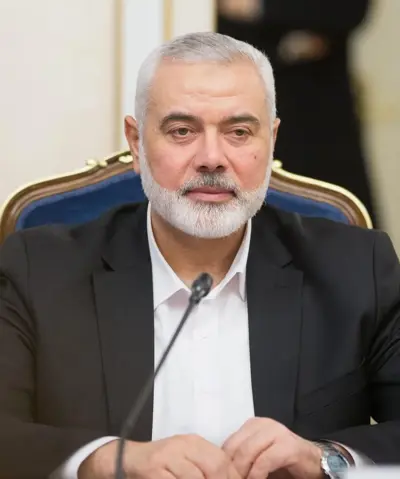
Ismail Abdel Salam Ahmed Haniyeh is a senior political leader of Hamas and formerly one of two disputed Prime Ministers of the Palestinian National Authority. Haniyeh became prime minister after Hamas won the Palestinian legislative elections of 2006. President Mahmoud Abbas dismissed Haniyeh from office on 14 June 2007 at the height of the Fatah–Hamas conflict, but Haniyeh did not acknowledge the decree and continued to exercise prime ministerial authority in the Gaza Strip. In September 2016, reports indicated Haniyeh would replace Khaled Meshaal as Chief of Hamas's Political Bureau. He was elected as Hamas political chief on 6 May 2017.
