Winston Churchill Quotes
The Newly established United Nations must be a force for action and not merely a frothing of words.
Winston Churchill 1874-1965, British Prime Minister (Conservative), 1946 Speech in Fulton, Missouri, Quoted in Foreign Policy, May/June 2007
Sourced by: Eigen's Political and Historical Quotations


He used the “united nations” as a general description as the UN had not been created or named yet, However, as this quotation demonstrates, the President was already thinking about a UN idea, but as a realist, he explained that the great powers had to come to some agreement of interests. Actually China and France, at the time, would go along with whatever the United States and Britain wanted to do and had a great common interest, and there was already a strong association of interests between Britain and America. Russia was to be the problem and a complete common interest was never to be, but there was enough to get the United Nations started.

1st Earl Lloyd-George of Dwyfor. International organizations have been notoriously inept at protecting countries from aggression or minorities from persecution and ethnic cleansing and genocide. The Armenian genocide by the Turks was the exemplar at the time, but the UN peacekeepers refused to fight to prevent the Serbs from murdering 7,000 Bosnian Muslims. When they were protecting the Israeli-Palestinian borders, they did nothing to stop Arab Armies from attacking Israel right through the UN Troops. They did nothing to help prevent the Ruanda genocide. UN “troops” are rarely willing to risk their lives for the victimized people or the International Organization itself.

With Germany’s WWII history of military aggression, even over 60 years later, that country was very cautious about any use of military force and unilateral force was out of the question.

Actually it was the United States which insisted in the veto which required consensus of the great powers of the time. It was Russia which ended up using it far more often than any other nation.


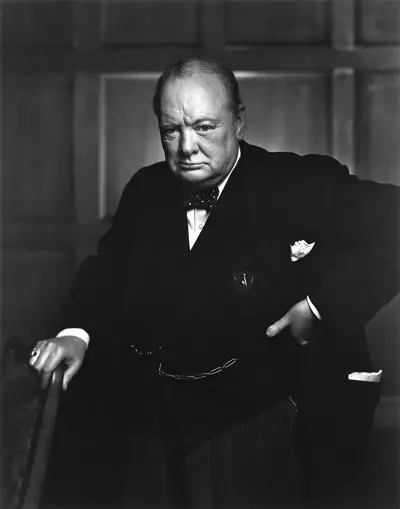
Sir Winston Leonard Spencer Churchill, KG, OM, CH, TD, DL, FRS, RA was the Prime Minister of the United Kingdom from 1940 to 1945, during the Second World War, and again from 1951 to 1955. Apart from two years between 1922 and 1924, Churchill was a Member of Parliament (MP) from 1900 to 1964 and represented a total of five constituencies. Ideologically an economic liberal and imperialist, he was for most of his career a member of the Conservative Party, as leader from 1940 to 1955. He was a member of the Liberal Party from 1904 to 1924. Churchill was also well known for his military career and as a historian, painter and writer, and among his many awards was the Nobel Prize in Literature.
