Karl Marx Quotes
The need of a constantly expanding market for his products chases the manufacturer over the whole surface of the globe. They must nestle everywhere, settle everywhere, establish connections everywhere.
This is one of the first recorded recognitions of globalization as an economic force.
Karl Marx, 1818-1883, German Economist & Socialist, The Communist Manifesto, 1848
Sourced by: Eigen's Political and Historical Quotations

While Wilson is often thought of a humanist and a man committed to World peace and national rights of independence, he was also a committed economic imperialist. See {585454} for another example.


The industrial revolution was also creating an entirely new form and structure for international economics.


Critics of this idea ask what we do when the minority of fanatic terrorists attack our troops and officials who have "brought" the rule of law to a "rogue state" like Somalia. Suicide bombers and others who want only the rule of Islamic Sharia law as opposed to rule of our law.

Despite this economic reality, many underdeveloped nations sell their raw materials because it is easier than the alternative which takes capital investment in processing plants and equipment, training of workers, and establishing a marketing mechanism. Most third world nations are limited in their capacity to do this but they have abundant natural resources.


This quotation is an amazing prediction that was 100 years in the future. China had a mercantile culture and tradition that was suppressed and controlled by the Emperors, the Europeans, the Nationalist Chinese, the Japanese, and finally the Communists who finally found a way to provide commercial freedom if not political, religious, and cultural liberty. But the talent for commerce was clear even 100 years ago to those who were broadminded enough to see it behind the antl-Asian prejudice of the 19th and early 20th century.


The most successful way of poor nations developing rapidly is to trade with rich nations.


It is very easy for an American company to make parts in the United States, ship them to Mexico for assembly and bring the finished product back. However, for counties like France it is much more difficult.


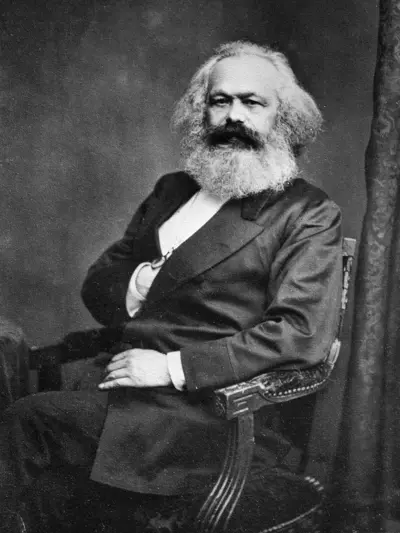
Karl Heinrich Marx was a German philosopher, economist, historian, sociologist, political theorist, journalist and socialist revolutionary. Born in Trier, Germany, Marx studied law and philosophy at university. He married Jenny von Westphalen in 1843. Due to his political publications, Marx became stateless and lived in exile with his wife and children in London for decades, where he continued to develop his thought in collaboration with German thinker Friedrich Engels and publish his writings, researching in the reading room of the British Museum. His best-known titles are the 1848 pamphlet The Communist Manifesto and the three-volume Das Kapital (1867–1883). Marx's political and philosophical thought had enormous influence on subsequent intellectual, economic and political history. His name has been used as an adjective, a noun, and a school of social theory.
