Ahmed Zewail Quotes
The Muslim Brotherhood and the Salifist parties are a real force in the Egyptian society. No civil, liberal government can succeed, even after new elections, if the Islamists are forced to work underground as a foe and the country remains divided.
Zewail, Ahmed. Reflections on World Affairs: Peace and Politics. Imperial College Press, 2015.


He was comparing the Muslim Brotherhood and ISIS. H was trying to eradicate both organizations. Most Western leaders saw the Muslim Brotherhood as a less dangerous and less virulent organization than ISUS, HAMAS and other more overt terrorist organizations. Siri however has perspective of owe 50 years of history with the Muslim Brotherhood, and although they have got through periods of claimed political participation and not terrorism, Sisi and other Egyptians observe that all of these more virulent terrorist troops share the same ideology and end goals as the Muslem Brotherhood, and all these terrorist groups have been outgrowths of the Muslim Brotherhood. H argues that the Brotherhood must be wiped out else there will be more and more terorist groups to replace those that we might destroy.

Actually, this is a relatively new phenomenon. Before this, it was the Western Colonialists who were to blame. Before that it was the Ottoman Turks who occupied their land, and before that it was the Christian Crusaders. Since the Arab countries have started their decline from one of the most advanced people and cultures of the world to one of the least, they have always found some external source to blame. Many scholars observe that that process of blaming others and not looking inward and avoiding the reforms that other religions and cultures went through is among the biggest reasons for their decline.


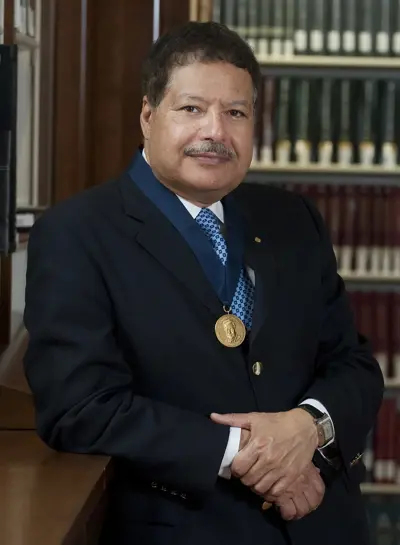
Ahmed Hassan Zewail was an Egyptian-American chemist, known as the "father of femtochemistry". He was awarded the 1999 Nobel Prize in Chemistry for his work on femtochemistry and became the first Egyptian to win a Nobel Prize in a scientific field. He was the Linus Pauling Chair Professor of Chemistry, Professor of Physics, and the director of the Physical Biology Center for Ultrafast Science and Technology at the California Institute of Technology.
