Henry Clay Quotes
The moment that the incontestable fact is admitted, that the slaves are property, the law of movable property irresistibly attaches itself to them, and secures the right of carrying them from one State to another.
Henry Clay, 1777-1852, U.S. Congressman and Senator (National Republican & Whig, KY), Speaker of the House, U.S. Secretary of State, Senate Debate, February 7, 1839
Sourced by: Eigen's Political and Historical Quotations

Van Buren was Ambassador to England at the time.


By not dealing with the issue of slavery early in America’s history when it was a very small economic factor in American society, our ancestors delayed action to the point where the economic factor was the overwhelming practical impediment to abolition.

Baron Brougham and Vaux


When Kansas was a territory and being considered for statehood, slavery was paramount politically in the nation and in Kansas in particular. There was terrible violence against “immigrants: from the East who would vote to make Kansas a free state and retaliation against the southerners and pro-slavery sympathizers. A constitutional convention was called in the town of Lecompton of the then Kansas Territory. The convention was dominated and controlled by slavery advocates and free soilers boycotted rather than give legitimacy to a constitution where they would lose. The quotation would settle the issue of slavery for Kansas the conferees thought. President Buchanan tried to steer the Lecompton Constitution through Congress, but there was enough opposition to block it. Congress decreed a Kansas referendum. The slavery forces lost and Kansas entered as a free state; there were 3 additional constitutional conventions which passed 3 different constitutions before one was settled upon.


Abolition was an issue from the first Congress onward. By the 1850s there was a major, and in the view of the Southern Slavery enthusiasts, incessant political, journalistic, and intellectual attacks on slavery. The latter two really affected public opinion and opposition to slavery grew in intellectual and educated circles. This document was an example of the literature of the time where the attack on slavery was made by simply explaining the “logic and facts” of the existing laws of the slave states. Once exposed in their entirety, the horror and immorality of the institution was supplemented by the intellectual absurdity and logical fallacies of the pro slavery forces. Note the swipe Goodell takes at Congress. This kind of public criticism made it harder and harder for the Northern Congressmen to “go along” with the South on the slavery issue, and the next decade of increased polarization on slavery culminated in the Civil War. It was not the Southern representatives who changed, but consciousness raising and public opinion changed the Northern perspective and the voting of the Northerners to oppose slavery. Earlier “compromises” became no longer morally or politically acceptable.
Providence, a large shipping center, not only shipped Southern Cotton, but was the home port of some of the major slave traders who brought and sold slaves to the South.

Since a slave was not a person, he/she could not accept any gifts or own any property. They were themselves property. The Greeks, the Romans, the ancient Germans, the Poles, with the Portuguese, the Spanish and the French had provided, both by law and by custom, for the possession of property by the slave, which could, not be seized by his master. This is another sense in which American slavery was even worse than most slavery had been.

What makes this quotation so historically interesting is that the abiding by the Supreme Court’s decisions on constitutionality was even an issue. It was because of the terrible Dred Scott decision which required Northern States to return fugitive slaves to their owners despite the constitutions of those states which stated that all men were free. A substantial part of the Democratic Party was the “solid South” and the return of fugitive slaves was one of the major issues of the 1860 Presidential Election. Ironically, the Southern States were arguing AGAINST states’ rights when the Northern States’ laws and Constitutions made fugitive slaves free the minute they set foot in the state.


The Mormons were in Missouri at the time. Phelps was warning the church members essentially not to get involved with the slavery issue. The Mormon Church tended to support the institution of slavery at that time although Mormons themselves did not own slaves. However, we should remember that the Mormons themselves were a very persecuted group and Phelps and other Church leaders probably didn’t want their members alienating the non Mormons more than they already did by their existence. This was very similar to the Roman Catholic Church leaders at the time. The Catholics were also a persecuted minority and the Catholic Bishops often supported slavery—especially in the South to try and avoid hostility from the power structure and the majority. Some individual Mormons and individual Catholics were much opposed to slavery. See {629158} and {629154} for more on the Mormons and slavery. Later, Smith altered his early view.
When the first Southern States seceded, each appointed a whose job it was to persuade the other Southern States to also secede. In this case Hale was marketing secession to Kentucky which with Maryland were the only two Southern States to reject what they regarded as treason and rebellion. The importance of the quotation however is in his argument which was all based on enmity to racial equality and abolition. Later Southern apologists would argue that the Civil War was fought, not about slavery and racism butt about different philosophies of government. See {623715} .


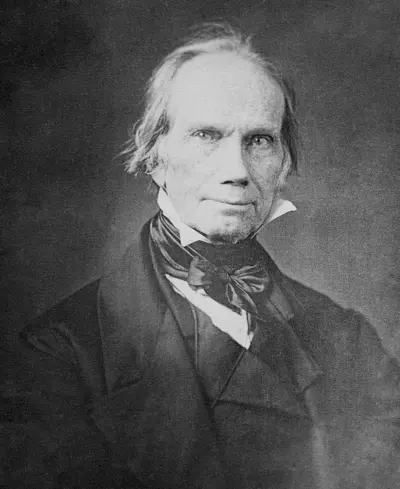
Henry Clay Sr. was an American attorney and statesman who represented Kentucky in both the Senate and House. He was the seventh House Speaker and the ninth Secretary of State. He received electoral votes for president in the 1824, 1832, and 1844 presidential elections. He also helped found both the National Republican Party and the Whig Party. For his role in defusing sectional crises, he earned the appellation of the "Great Compromiser" and was part of the "Great Triumvirate".
