Max Weber Quotes
The modern view of criminal justice, broadly, is that public concern with morality or expediency decrees expiation for the violation of a norm; this concern finds expression in the infliction of punishment on the evil doer by agents of the state, the evil doer, however, enjoying the protection of a regular procedure.
Weber, Max. Max Weber on Law in Economy and Society, edited by Max Rheinstein, translated by Edward Shils and Max Rheinstein, Harvard University Press, 1954, p. 46.


The issue was whether the Federal government could enforce a federal law against a citizen of a state if the state did not agree. There were some who argued that the State had the supreme authority over any citizen within the state. That view has been rejected and the Federal government may enforce its laws on anyone in any state regardless of the views of the state.


As this quotation demonstrates, this problem has plagued America for a long time. In terms of crimes committed, for example, General Electric Corporation has committed more crimes than any other criminal enterprise, but it thrives despite this and the penalties are seen as just a slap on the wrist when they do get caught but they do not even get prosecuted for many of their crimes like most large corporations and rich individuals who commit crimes. The people who go to jail are usually the lower level or middle level criminals and the kingpins, the ones with the control and the money, rarely even get prosecuted. In the Great Recession, the largest banks in America committed tens of thousands of serious crimes by forging signatures and making false claims on legal documents. Not a single executive ever went to jail or was even given a suspended sentence. The banks paid small fines.


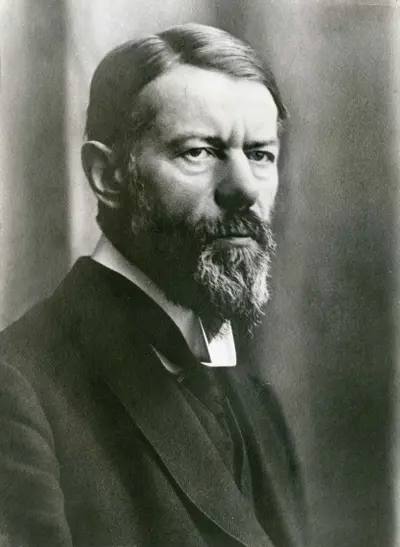
Maximilian Karl Emil Weber was a German sociologist, historian, jurist, and political economist, who is regarded among the most important theorists on the development of modern Western society. His ideas would profoundly influence social theory and social research. Despite being recognized as one of the fathers of sociology, along with Auguste Comte and Émile Durkheim, Weber never saw himself as a sociologist, but as an historian.
