Samuel Chase Quotes
The jury has the right to determine both the law and the facts.

Ever since that decision was written, lawmakers, judges and attorneys have worked very hard to minimize its impact and allow the jury to only decide on the facts and not the law. Only Maryland today preserves the right of the jury to decide what the law means and to judge it. Authorities, even democratic ones, do all they can to prevent what is called “jury nullification”. Regardless, juries often exercise that right regardless of the judge’s instructions.

This is a very important and fundamental quotation. Jefferson, John Adams, John Jay and many other Founding Fathers told us that the jury of peers was the final arbiter of a court case. However, many modern judges and legislatures have tried to erode that principle. In most states judges instructs juries that they are the final arbiter of the facts but he/she is the final arbiter of the law and how it should be applied in the case. But the founders wanted the jury to be the final arbiters of the law as well as the facts as is illustrated here and in {640587} and {640589}. For a more modern concurring view, see {640590}.
This principle that the jury may, if it chooses, decide on the law and not neccessarily follow the Judges instructions on the law was held by John Adams and John Jay, the first Chief Justice of the Supreme Court, as well as political and judicial leaders throughout American History. But in the 20th century the Judiciary and many legeslatures has tried to restrict taht freedom of the Juries. At the beginning of the 21st Century, the only state whose laws explictly followed that practice was Maryland, and even there, very few judges ever informed juries that they could override or ignore him on matters of law.


Note that in his very definition of a Petty Jury the right of the jury to ignore the judge's instructions in criminal matters wasa assumed--not some novel idea. Jury nullification has been a part of the American Criminal Justice System from the inception of the nation.


Federal officials and commissioners issued laws, directives and orders that were very unpopular with the Mormons who were in the overwhelming majority of the Utah territory. The Mormon “government” was a type of theocracy but a very popular one. The Mormons tried to test the constitutionality and legality of the Federal laws and orders before they would obey. The government position was that they should obey and then could test the laws in the courts. The Mormons eventually lost in the courts anyway, but the principle of obedience to law until it can be tested and reversed has generally been the rule of U. S. Law. However, civil disobedience in which many religions have engaged in our history argues the obverse. Eventually Taylor had to go “underground” and rule the church from exile in which state he died.
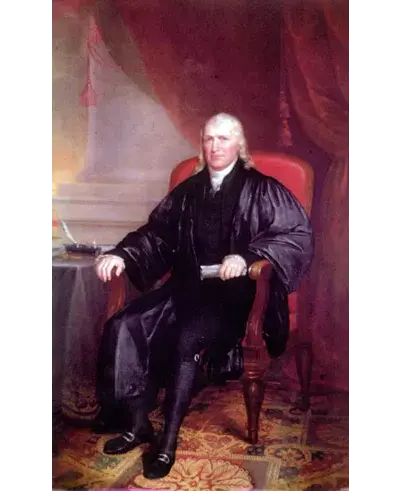
Samuel Chase was an Associate Justice of the United States Supreme Court and a signatory to the United States Declaration of Independence as a representative of Maryland. He was impeached by the House of Representatives on grounds of letting his partisan leanings affect his court decisions but was acquitted by the Senate and remained in office.
