Hassan Al-Turabi Quotes
The Islamic awakening began as a spiritual, an individual event, but it has become increasingly political.
Hassan Al-Turabi, Sudanese Philosopher and Government Advisor, Speech, Center for Strategic and International Studies, Washington DC, May 1992
Sourced by: Eigen's Political and Historical Quotations


Religious obligation of Islam requires all Muslims to try and convert all others. However that is not different from some of the Christian, fundamentalist religions where attempted conversion of non-believers is a duty. However, where many in the Islamic world see that obligation as a peaceful, nonviolent, effort to persuade others to accept Islam, there are many others who believe that Jihad should impose Islamic law—Sharia—upon the world and the use of force and violence is not only acceptable but is necessary and desirable to achieve their objection.

The party to which he was referring was the Ennahda Party of which he was a founder. Note that party's acknowledgement that Islamic extremists had hijacked the terms "Islamic" and "Islamism", thus requiring them to change vocabulary to distinguish themselves and their more democratic values.

Note that Khomeini realized that America assisted Saddam Hussein. We ended up being the enemy of both.
The notion that Islam would be practiced by individuals was in the Ayatollah’s view insufficient. Islam must also control the government—the head.


The Caliph in the past was the religious and secular leader of all Muslims. Many of the fundamentalist terrorists have as their objective, the reestablishment of the Caliphate which will unite all Islamic countries under one leader who is both the secular and religious supreme authority—a religious and a civil dictatorship. Most Muslims, like most people of all religions, are not terrorists and believe that much of terrorist activity violates many basic tenets of Islam. However, in order to function, the terrorist must have the tacit support of sufficient numbers of people so that they can function without being exposed. That is an important objective for Al-Qaeda: to enlist sufficient numbers of ordinary people who although they will not commit the terrorist acts, will support the objectives of the terrorists and provide money, shelter, and other services.
Here Khomeini takes the classic Islamic view of the Koran that leaders should be obeyed unless they do not follow Islam. To the leaders of Islamic nations, this means that even if the state is not a theocracy, the Muslim clergy has the final say as to whether a ruler may justly remain in power since they are the ones who determine if a ruler is properly following Islam.
This quotation helps to explain the religious revelry in military achievements in Islam.


Bangladesh had fared very poorly as a part of Pakistan. When it revolted and became independent, it adopted a secular government whereas Pakistan had been, and is, a heavily Islamic state. However, the vast majority of Bengalis were Muslim and some were extreme fundamentalists. Rahman was under constant pressure to make the government more “Islamic” and while he did so somewhat, he tried to advocate for separation of church and state. Bangladesh is not as extreme as Pakistan which is not yet a theocracy but religious forces dominate every aspect of the society.
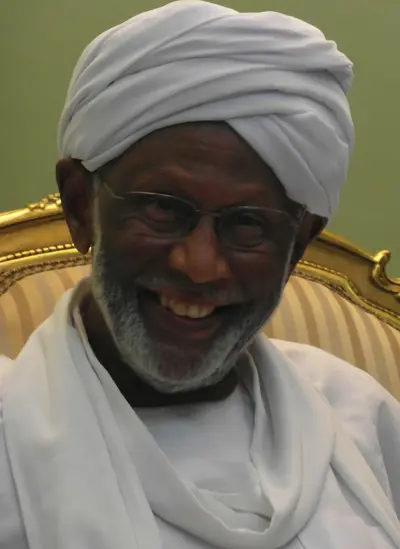
Hassan 'Abd Allah al Turabi was a Sudanese Islamist politician who was considered "the true architect" of 1989 coup that brought Omar Al-Bashir to power. He has been called "one of the most influential figures in modern Sudanese politics", and a "longtime hard-line ideological leader". He was instrumental in institutionalizing sharia (Islamic law) in the northern part of the country and was frequently imprisoned in Sudan, but these "periods of detention" were "interspersed with periods of high political office".
