Karl Marx Quotes
The Irish famine of 1846 killed more than 1,000,000 people, but it killed poor devils only. To the wealth of the country it did not the slightest damage.
Many have argued that if the Irish famine had affected the wealth of the country, the problem would have been solved. The vast majority of the dead Irish were unskilled peasants who were not needed for their labor. Therefore, no one had a vested economic interest in ending the starvation, and the people who had the moral motivation to do so did not have the means or the skill to do so.
Karl Marx, 1818-1883, German Economist & Socialist, Das Kapital (Book I), 1867
Sourced by: Eigen's Political and Historical Quotations


This was written in 1933 one of the worst years of the Great Depression. Actualy many upper middle calss and rich people were ruined themselves by the Great Depression, but at the same time the ultra rich were living in a "gildd age" and reveled ostentatiously.


Most people who hear this quote for the first time assume that it originates with some radical socialist of the 1930s. However it came from a President of the United States and a Republican President at that. Few scholars will place this quotation correctly.


Bryan's concept of struggling masses included farmers and small businessmen.


Reflection on the Irish Potato Famine of 1845-1850
He was discussing the situation on the Potato Famine in Ireland of 1845-1850. Note his focus on increasing mass expectations.

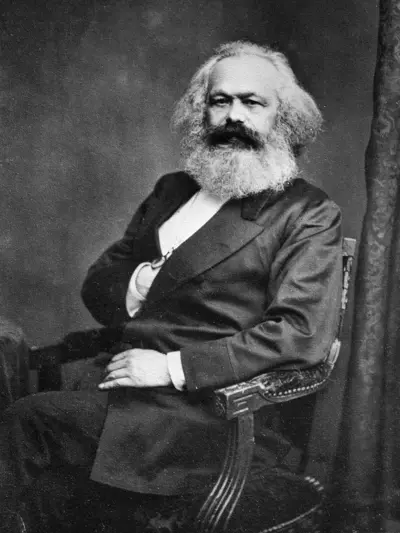
Karl Heinrich Marx was a German philosopher, economist, historian, sociologist, political theorist, journalist and socialist revolutionary. Born in Trier, Germany, Marx studied law and philosophy at university. He married Jenny von Westphalen in 1843. Due to his political publications, Marx became stateless and lived in exile with his wife and children in London for decades, where he continued to develop his thought in collaboration with German thinker Friedrich Engels and publish his writings, researching in the reading room of the British Museum. His best-known titles are the 1848 pamphlet The Communist Manifesto and the three-volume Das Kapital (1867–1883). Marx's political and philosophical thought had enormous influence on subsequent intellectual, economic and political history. His name has been used as an adjective, a noun, and a school of social theory.
