Aristotle Quotes
The high-minded man is fond of conferring benefits, but it shames him to receive them.
Aristotle. The Nicomachean Ethics. Translated by David Ross, Oxford University Press, 2009, p. 63.


This quotation is very important because it helps readers to understand the problem that the Native Americans have had dealing with land treaties and transactions and the difficulty many Native Americans have had with the concept of paid jobs and working for hire—hence being very successful in a European style capitalistic economy.


Even before being an independent country, America had two contrasting and contradictory views of patents—the one that Franklin herein states and the one what was written into the constitution that argued that by granting patents inventors would be incentivized to make their trade secrets public if they had an exclusive monopoly on if for a period of time. Both of these philosophies towards patents have coexisted since then. There was a Federal patent system for those who wanted to use it, and for those who did not, they could enter the invention to the public domain as Franklin urged. Arguably, we have obtained the best of both approaches. Millions of patents have been filed and granted and yet some of the most important inventions have followed the Franklin approach. See the quotes about the Salk Polio Vaccine—{29154} and {29187} and the quote on "open source" computer software—{29676}. With billions of dollars being made by protected software in the early 21st century, over half of the world's computers were operating on systems that was public domain and without charge as just one large example of the Franklin philosophy still coexisting.

Previous Sultans had developed a large army of Black Moors. Then there was a civil war in Morocco where the light skinned Moroccans fought against those of dark skin. The light skins won and the new Sultan ordered the remnants of the Black soldiers with their families to Larache where he surrounded them by Arabs and simply gave the Blacks to the light skinned Arabs as slaves.
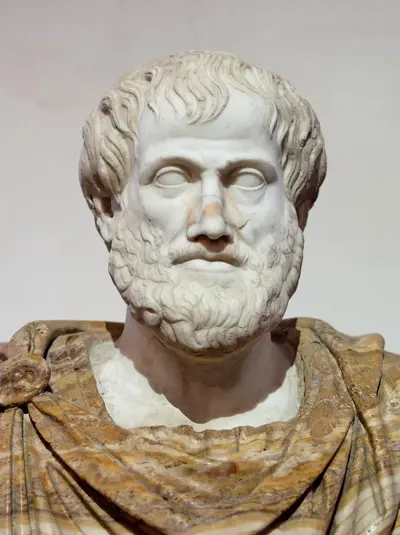
Aristotle (/ærɪˈstɒtəl/; Greek: Ἀριστοτέλης Aristotélēs, pronounced [aristotélɛːs]; 384–322 BC) was a Greek philosopher and polymath during the Classical period in Ancient Greece. Taught by Plato, he was the founder of the Lyceum, the Peripatetic school of philosophy, and the Aristotelian tradition. His writings cover many subjects including physics, biology, zoology, metaphysics, logic, ethics, aesthetics, poetry, theatre, music, rhetoric, psychology, linguistics, economics, politics, meteorology, geology and government. Aristotle provided a complex synthesis of the various philosophies existing prior to him. It was above all from his teachings that the West inherited its intellectual lexicon, as well as problems and methods of inquiry. As a result, his philosophy has exerted a unique influence on almost every form of knowledge in the West and it continues to be a subject of contemporary philosophical discussion.
