George F. Will Quotes
The First Amendment...begins with the five loveliest words in the English language: 'Congress shall make no law'.
Will, George F. The Morning After: American Successes and Excesses, 1981-1986. Free Press, 1986, p. 117.


Striking down a law making cross burning a crime:


This law would certainly be held unconstitutional today but at the time it wasn’t even clear that the Supreme Court could nullify a law of Congress. Virginia and Kentucky both passed resolutions however, protesting the law and challenging its constitutionality. The $2,000 maximum fine was huge for the day—the equivalent of more than $1 million today. The reason was that one of the major targets of the law was wealthy printers and publishers, who could be impoverished for a violation. The Sedition Act was in existence until Jefferson ousted the Federalists who passed it (John Adams signed it) and pardoned all those who had been convicted under the law. The Sedition Act is used today as evidence that the Founding Fathers really did not intend that the First Amendment protect speech that is potentially harmful to the country. The counter argument is that the Sedition Act was passed by John Adams and his allies at a particularly vulnerable time in America’s early history. And it was one of the biggest reasons that Adams and the Federalists were defeated after a single term by Thomas Jefferson and the Democrats. The Federalists were so badly beaten that their entire political party was destroyed. The Whig Party evolved as the opposition Party to Jefferson and the Democrats.


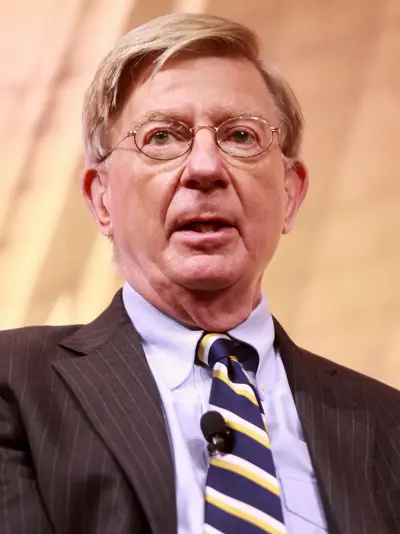
George Frederick Will is an American libertarian-conservative political commentator and author. He writes regular columns for The Washington Post and provides commentary for NBC News and MSNBC. In 1986, The Wall Street Journal called him "perhaps the most powerful journalist in America," in a league with Walter Lippmann (1889–1974). He won the Pulitzer Prize for Commentary in 1977.
