George F. Will Quotes
The Federal guild system ... was crony capitalism before there was capitalism.
George Will, Political Columnist, The Washington Post, Column, October 12, 2014
Sourced by: Eigen's Political and Historical Quotations


He and his brother were the largest political contributors in the United States, so they had enormous influence on Republicans (they only made political contributions to conservative organizations).


While this is a common complaint in the American political dialogue at the beginning of the 21st century, it is interesting that this was the conclusion of a foreign political scholar studying that period—one who was generally a great admirer of America.


The George W. Bush administration was a throwback to an earlier era where such a spoils system was operational. Reforms had almost eliminated this type of contractor political favoritism but a culture of political corruption had developed in Congress and the Executive branch in the early 21st century that was more reminiscent of a more than a hundred years earlier. See {589738} for one of the examples that triggered the editorial.

The “regulation” to which Franklin objected was not the type of regulation we have today. It was generally limited to the granting of monopolies to individuals or their companies if they would institute a service that was perceived as beneficial by the public as a whole. For example, a company might build steamboats and provide regular service across a river or along it. The company would argue that the initial cost and investment is so great, that they are entitled to a period of protection so that they can be sure of getting their investment back. In most cases, they would have made the investment, monopoly or not, and in many cases the public officials are unsophisticated and make a bad deal; in others there was (and is) outright corruption. Countries like Norway, have been so burned by the problem Franklin observed, that they try to avoid even government monopolies of service. They for example, have private and public light rail commuter lines which continuously compete against each other.


This criticism of business has been made ever since by many opposed to protectionism, corporate welfare, subsidies, and bailouts. Yet they get bigger each decade.

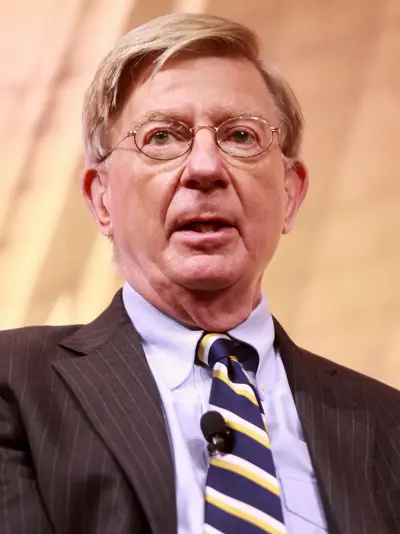
George Frederick Will is an American libertarian-conservative political commentator and author. He writes regular columns for The Washington Post and provides commentary for NBC News and MSNBC. In 1986, The Wall Street Journal called him "perhaps the most powerful journalist in America," in a league with Walter Lippmann (1889–1974). He won the Pulitzer Prize for Commentary in 1977.
