Louis D. Brandeis Quotes
The doctrine of separation of powers as adopted by the [Constitutional] Convention of 1787 not to promote efficiency but to preclude the exercise of arbitrary power. The purpose was not to avoid friction, but, by means of the inevitable friction incident to the distribution of the governmental powers among three departments, to save the people from autocracy.
Louis D. Brandeis, 1856-1941, U. S. Supreme Court Justice, Dissent, Myers v. United States, 1926
Sourced by: Eigen's Political and Historical Quotations


There was much argument over the desired relative strength and power of the three branches of government. Wilson suggested equality. We argue about it to this day.


See Louis Brandeis for a later judicial interpretation of this view.


Randolph was one of the delegates who opposed a Presidency of a single man.


At that point in American History there were some who thought that the Congress was aggregating too much power. At the beginning of the 21st century we bemoaned a weak Congress and worried about an imperial and too powerful an executive while a few thought that the Judicial branch had become too powerful in “legislating from the bench.”


The drafters of the Constitution were well aware of this view of Montesquieu’s which was one of the main bases of separation of powers and checks and balances in America.

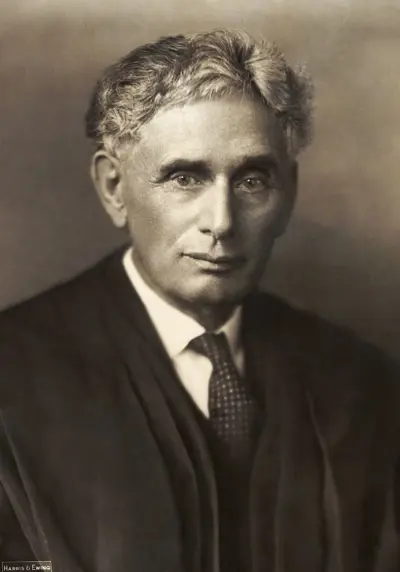
Louis Dembitz Brandeis was an American lawyer and associate justice on the Supreme Court of the United States from 1916 to 1939. He was born in Louisville, Kentucky, to Jewish immigrant parents from Bohemia (now in the Czech Republic), who raised him in a secular home. He attended Harvard Law School, graduating at the age of 20 with the highest grade point average in the law school's history. Brandeis settled in Boston, where he founded a law firm (that is still in practice today as Nutter McClennen & Fish) and became a recognized lawyer through his work on progressive social causes.
