Albert Einstein Quotes
The discovery of nuclear reactions need not bring about the destruction of mankind any more than the discovery of matches.
Einstein, Albert. "Atomic War or Peace." The Atlantic Monthly, vol. 176, no. 5, Nov. 1945, p. 43.


Morrison was then a graduate student of Oppenheimer. The quotation is important, not because it shows how quickly the “father of the atomic bomb” realized that a nuclear bomb could be made and how, but how relatively easy and rapid it was for a competent theoretical physicist could conceptually design a nuclear weapon if they first had knowledge of the Hahn / Strassmann Experiment and the Meitner / Frisch explanation of what had happened ({640924}). Note Leo Szilard’s letter at about the same time--{640925}.


Meitner and her nephew Frisch had been the first people to realize that the atom had been split. Meitner had described the process to her nephew and he made some drawings of the process she described. A few of these looked like a bacteria dividing. Frisch happened to meet with William A. Arnold, an American Biologist doing research in Stockholm. He asked Arnold what the biologists called it when a bacteria divided, and he replied, “fission”. Frisch told his aunt and she decided that they should use that term in the scientific article they were preparing on the splitting of the atom.


The Scientific Project that developed the Atomic Bomb. In the development of the atomic bomb there was a hypothetical possibility that the Earth as we know it might be destroyed. Robert Oppenheimer the scientist who directed the bomb development and his staff framed the question which Oppenheimer presented to Arthur Compton. The decision was that Oppenheimer’s team would calculate every possibility and make sure that such a catastrophe was not within the realm of possibility. They did all the calculations, concluded that there was no possibility, the bomb was exploded, and the question was then finally answered in the negative.


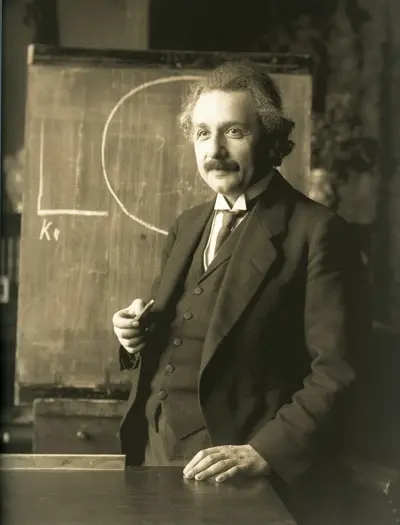
Albert Einstein was a German-born theoretical physicist, widely acknowledged to be one of the greatest physicists of all time. Einstein is known for developing the theory of relativity, but he also made important contributions to the development of the theory of quantum mechanics. Relativity and quantum mechanics are together the two pillars of modern physics. His mass–energy equivalence formula E = mc2, which arises from relativity theory, has been dubbed "the world's most famous equation". His work is also known for its influence on the philosophy of science. He received the 1921 Nobel Prize in Physics "for his services to theoretical physics, and especially for his discovery of the law of the photoelectric effect", a pivotal step in the development of quantum theory. His intellectual achievements and originality resulted in "Einstein" becoming synonymous with "genius".
