Francisco de Cuellar Quotes
The custom of these savages is to live as brute beasts in the mountains which are very rugged in that part of Ireland where we lost ourselves. They are great walkers, and inured to toil. The men are all large-bodied, and of handsome features and limbs and are as active as deer. The most of the women are very beautiful but badly got up. They do not eat more than once a day, and this is at night; and that what they usually eat is butter with oat bread. They drink sour milk, for they have no other drink; they don’t drink water although it is the best in the world. In feast days they eat some meat half-cooked without bread or salt as that is their custom.
His memoir is one of the best descriptions of the Irish people at the time. Note that this was before the potato was introduced into Ireland from South America. One of the most interesting things about the Irish at the time is that they did not drink water or eat fish while both were very abundant and of very high quality. The Captain had broken formation in the 1588 Great Armada defeat by England and was ordered onboard another ship of officers to be disciplined (scapegoats for the defeat). His ship was severely damaged, blown off course, and wrecked on the Irish coast. Note that he refers to the Irish as “savages” which was in comportment with the English perception of the Irish at the time—see {639438}. When shipwrecked the Irish robbed and stripped the Spaniards of every shred of their clothing, but they did not kill the few Spaniards who were left alive. They lived off roots and plants until they ran into other Irish who saw them as allied Catholics against the hated English. These Irish assisted them from being captured by the English and helped the escape back to Spain in a small boat.
Francisco de Cuellar, 16th Century, Spanish Sea Captain in the Armada, Memoir of his experience being shipwrecked on the Irish Coast
Sourced by: Eigen's Political and Historical Quotations

This was the at the time, a typical assessment of the English, Welsh and Scotts about the Irish who were perceived as a lower class of nation. Most interesting was the irreligious perception of a people who would become the most faithful and orthodox of Roman Catholics.


1st Earl of Beaconsfield. In the United States, President Theodore Roosevelt shocked the major business interests when he proposed regulating food and other government quality assurance of the private marketplace. Many Americans saw this as an overdue reform. One of the reasons was that Prime Minister Disraeli had advocated government regulation a quarter of a century earlier with statements like this quotation.


This view generalized to almost all cultures almost defines the essence of conservatism.


The King was concerned because many of the English living in Ireland were “going native” and he also thought that if the Irish could become more civilized they could be assimilated instead of having to control them with expensive troops. To some extent this actually worked, especially in speaking English, but the entire law was very difficult to enforce. It did however, keep the Englishmen from departing from English dress, speech and household arrangements.

He had broken formation in the 1588 Great Armada defeat by England and was ordered onboard another ship of officers to be disciplined (scapegoats for the defeat). His ship was severely damaged, blown off course, and wrecked on the Irish coast. Note that he refers to the Irish as “savages” which was in comportment with the English perception of the Irish at the time—see {639438}. When shipwrecked the Irish robbed and stripped the Spaniards of every shred of their clothing, but they did not kill the few Spaniards who were left alive. They lived off roots and plants until they ran into other Irish who saw them as allied Catholics against the hated English. These Irish assisted them from being captured by the English and helped the escape back to Spain in a small boat.


Owner of one of the only 2 Mexican Television Networks


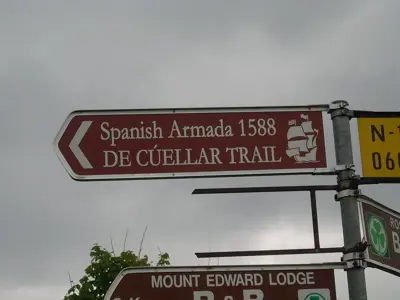
Francisco de Cuéllar was a Spanish sea captain who sailed with the Spanish Armada in 1588 and was wrecked on the coast of Ireland. He gave a remarkable account of his experiences in the fleet and on the run in Ireland.
