Andrew Gamble Quotes
The company has always been one of the great mysteries of capitalism: liberals and socialists have never known quite what to think about it. The company is collectivist and co-operative, based on hierarchy, bureaucracy and planning rather than individualism, competition and exchange. Companies appear as little islands of socialism in the market sea.
Andrew Gamble, British Historian, "Little Islands." London Times Literary Supplement, January 16, 2004
Sourced by: Eigen's Political and Historical Quotations

The socialist extremists wanted the state to own all the major businesses which would be operated without a profit allowing more money to be paid to the workers without any price increase for the consumer. Yet, many of them wanted the innovation and other virtues of the private sector and few were ready to take on the political chaos that would be involved in eliminating private ownership of businesses. Crosland forced them to logically accept the concept of profits as desirable for the society.


She was then the European Commissioner for Competition.
She was then the European Commissioner for Competition


[Most theoretical conservative economists believe this. When presented with the reality of market systems where great damage was done to people and areas, as in the Great Depression of 1929 and the Great Recession in 2008, they tend to argue that these were not really free markets—–that for various reasons, often they argue that government interference, corrupted the free market. Almost all economists would agree that if there were real highly competitive market his quote would be corrupt, but many have shown that the very greed that is produced by a free market tends to make the major players transform the market to reduce their risk and increase their power, thus producing monopoly, oligarchy, collusion, and anti-competitive practices. Greed is never harmless if it gets enough power.]


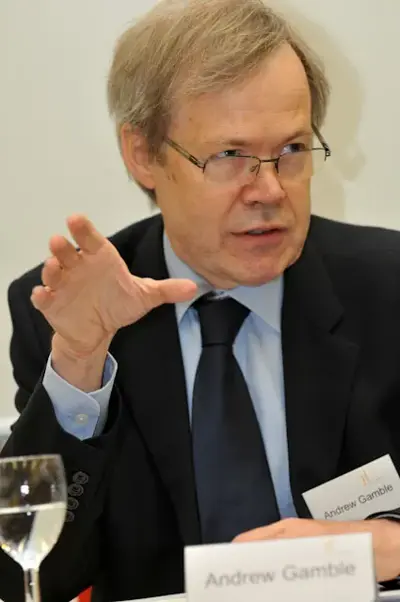
Andrew Michael Gamble FRSA FBA FAcSS is a British academic and author. He was Professor of Politics at the University of Cambridge and Fellow of Queens' College from 2007 to 2014. He was a member of the Department of Politics at the University of Sheffield (1973–2007), for many years as a professor and rejoined the department in 2014.
