Joseph Story Quotes
The common law has now become an exceedingly voluminous system; and as its expositions rest, not on a positive text, but upon arguments, analogies, and commentaries, every person who desires to know much must engage in a very extensive system of reading. He may employ half his life in mastering treatises the substance of which, in a positive code, might occupy but a few hundred pages. The codes of Justinian, for instance, superseded the camel-loads of commentaries which were antecedently in use, and are all now buried in oblivion. The Napoleon Codes have rendered thousands of volumes only works of occasional consultation which were before required to be studied very diligently, and sometimes in repeated perusals.
Joseph Story, 1779-1845, U. S. Supreme Court Justice, 1835
Sourced by: Eigen's Political and Historical Quotations


Perhaps this is one of the reasons American society is so litigious.


He had visited the House of Commons. The “problems” resulted from the fact that the English had to make their own laws rather than have them provided by God as in Islamic legal systems—Sharia.


It passed with 70 percent of the vote. It was triggered by a case in New Jersey where a Muslim man assaulted and raped his wife, and the Judge found that he did not have the “Criminal Intent” because he was brought up under Sharia law which allows a husband for beat a wife and force her to have sexual relations if she refused. The New Jersey appellate court overturned the judge’s decisions, but the Oklahoma advocates for the Question argued that this initiative would be sure that no judge in Oklahoma would make a similar judicial decision.


Appeals to Providence included Trial by Fire, Trial by Water and related Trial by Ordeal. See Wikipedia: http://en.wikipedia.org/wiki/Trial_by_ordeal for explanations of these.


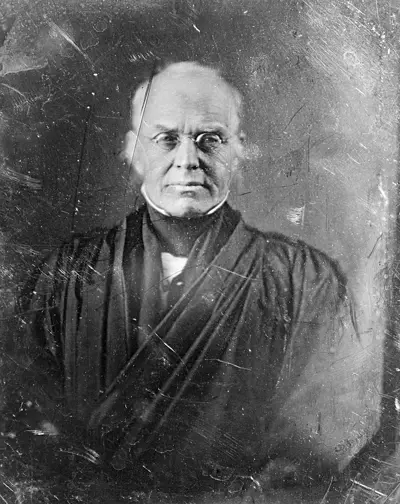
Joseph Story was an American lawyer and jurist who served on the Supreme Court of the United States from 1812 to 1845, during the Marshall Court and early-Taney Court eras. He is most remembered for his opinions in Martin v. Hunter's Lessee and The Amistad case, and especially for his magisterial Commentaries on the Constitution of the United States, first published in 1833. Dominating the field in the 19th century, this work is a cornerstone of early American jurisprudence. It is the second comprehensive treatise on the provisions of the U.S. Constitution and remains a critical source of historical information about the forming of the American republic and the early struggles to define its law.
