Clement of Alexandria Quotes
The birthday of Jesus
Clement of Alexandia was the first of the Christian theologians to consider and write about the birthday of Jesus, There was no celebration of Christ's birthday in the early centuries of Christianity. Clement offered seven dates in whuch he thought there was evidence of Christ's birthday. None of these was December 25. Christian celebration of the birthday of Christ did not take place until about the beginning of the 4th century. See the related Quotes for more about Jesus' Birthday.
Clement of Alexandria Quoted in Candida R. Moss "Five Myths: The Nativity The Washington Post, December 18, 2016
Sourced by: Eigen's Political and Historical Quotations

Prior to that there were few celebrations of Christ's birth and there was no official date agreed upon. there is no Biblical support for the notion that Christ was conceoved and crucified on the same day of the year and it is not known how this ideo originated, but it was part of of 4th century Chritian belief. December 25 is by no means a histotical date woth amy accuracy. These is some evdence to suggest that Chrsit was not even born iin December.
Not only was the month of Christ's birth propably erroneous, but the year certainly was. See Quotation 644128. The reason shepherds watch flocks of sheep at night during the lambing season is that the newborn lambs are prey to foxes and other animals what would not attack a full grown sheep.


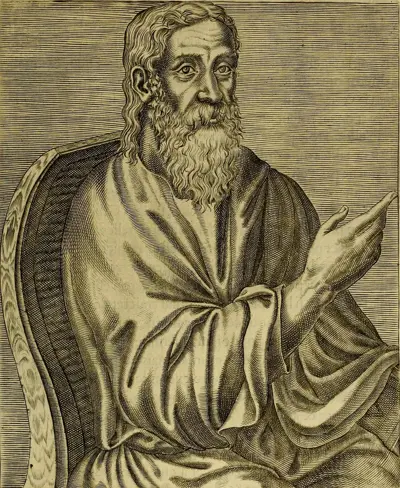
Titus Flavius Clemens, also known as Clement of Alexandria (Greek: Κλήμης ὁ Ἀλεξανδρεύς; c. 150 – c. 215 AD), was a Christian theologian and philosopher who taught at the Catechetical School of Alexandria. Among his pupils were Origen and Alexander of Jerusalem. A convert to Christianity, he was an educated man who was familiar with classical Greek philosophy and literature. As his three major works demonstrate, Clement was influenced by Hellenistic philosophy to a greater extent than any other Christian thinker of his time, and in particular, by Plato and the Stoics. His secret works, which exist only in fragments, suggest that he was familiar with pre-Christian Jewish esotericism and Gnosticism as well. In one of his works he argued that Greek philosophy had its origin among non-Greeks, claiming that both Plato and Pythagoras were taught by Egyptian scholars.
