John Stuart Mill Quotes
The average condition of the people improving or deteriorating, depends upon whether population is advancing faster than improvement, or improvement than population.
Mill, John Stuart. Principles of Political Economy. Vol. 1, John W. Parker, 1848, p. 228.


From a technical and production point of view, there is no practical limit to population size that is imposed by food production. We can produce sufficient food for the world even if population increases dramatically. None the less, even today we have some starvation and much malnutrition problems. These however are political, economic and tend to be distributional. We can produce the food. Morris does NOT advocate large population growth. Although food need not be a problem with an expanding population, job availability, medical care, energy, land, natural resources, ethnic hatred, migration, violence, and other problems are produced by population growth.

That was written in 1932. The benefits of man’s scientific and technical development had not reached all Americans or even most Americans. By the 1960s however these benefits were distributed to most Americans where the poor and middle class improved their share of the benefits of society both in terms of proportion and absolute improvement/ This increased till the Reagan administration and then slowed and really went backwards in the George W. Bush Administration.

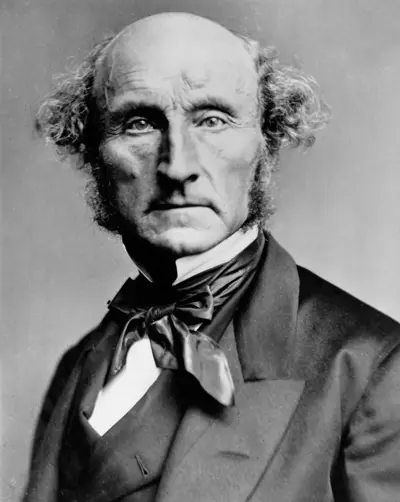
John Stuart Mill, usually cited as J. S. Mill, was an English philosopher, political economist, Member of Parliament, and civil servant. One of the most influential thinkers in the history of classical liberalism, he contributed widely to social theory, political theory, and political economy. Dubbed "the most influential English-speaking philosopher of the nineteenth century", he conceived of liberty as justifying the freedom of the individual in opposition to unlimited state and social control.
