Juvenal Quotes
The abject pleasure of an abject mind
And hence so dear to poor weak woman kind.
[Lat., Vindicta
Nemo magis gaudet, quam femina.]
Juvenal. Juvenal and Persius. Translated by G. G. Ramsay, Harvard University Press, 1918, p. 263.


This proverb doesn’t mean quite what it would appear to—that women will never be attacked in an act of revenge. It does mean that when relatives are selected for vengeance killing, or other acts of vengeance, women will not be selected. However in one tragic Pakistani case in 2003, a Muslim man had purportedly had an affair with a woman from another clan. That clan’s male relatives took revenge. A group of them gang raped a sister of the man who purportedly had committed the offense. The “logic” was that by raping the woman, they were destroying the honor of the brother’s family as they in their perception had had their family’s honor destroyed. The fact that it was the innocent woman who was brutalized didn’t enter into the equation—there was no direct intent to take vengeance on her; it was taken on her male relatives. Worse was the fact that a local “tribal court” had authorized the action as a “legal” act of “blood” or vengeance. The national government, embarrassed before the world, provided minor punishments to the rapists (death might have been a rapists penalty) and then honored the woman by naming a school after her. Unfortunately the family’s honor was destroyed and marriage for the woman was unlikely in that society. In addition to the great improvements and benefits brought to half the known world by the Islamic expansion out of Arabia, many of the less desirable Arab traditions went with them informally and formally as Sharia—Islamic Law.


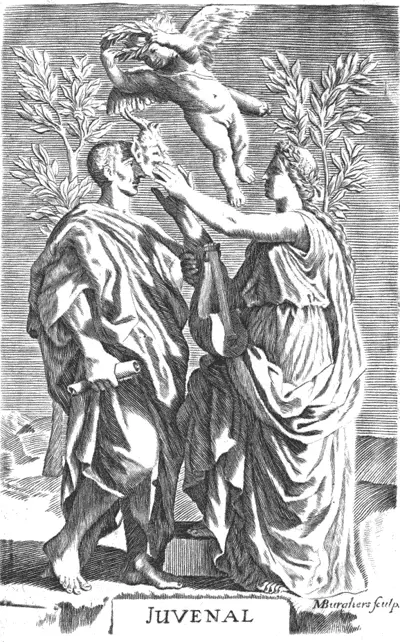
Decimus Junius Juvenalis (Latin: [ˈdɛkɪmʊs ˈjuːniʊs jʊwɛˈnaːlɪs]), known in English as Juvenal (/ˈdʒuːvənəl/ JOO-vən-əl), was a Roman poet active in the late first and early second century AD. He is the author of the collection of satirical poems known as the Satires. The details of the author's life are unclear, although references within his text to known persons of the late first and early second centuries AD fix his earliest date of composition. One recent scholar argues that his first book was published in 100 or 101. Because of a reference to a recent political figure, his fifth and final surviving book must date from after 127.
