George C. Marshall Quotes
Tell Groves to take care of his own dirty work.
Marshall was Army Chief of Staff at the time. Actually it was the OSS—the precursor to the CIA—that accepted the job of the assassination of Werner Heisenberg, the best physicist left in Germany after so many had escaped from the dictatorship. However, the agent who was to do the assassination made the judgment from actually talking with him and reading all his scientific papers that he was not working on an atomic bomb and really didn’t know of a lot of the critical research that was ongoing. He let the scientist live, and later investigations showed that the agent, Moe Berg, was absolutely right. Neither Heisenberg nor any other German scientists were working on atomic energy. The Germans had put all their scientific eggs in the rocket and jet plane basket.
George C. Marshall, 1880-1959, General & U. S. Army Chief of Staff, U. S. Secretary of State, U. S. Secretary of Defense, Nobel Peace Prize Winner (The only soldier ever so honored), Instructions to his assistants who had informed him that the military director of the Manhattan Project developing the atomic bomb—General Leslie Groves—wanted the Army to assassinate German civilian scientists who might be developing a German bomb
Sourced by: Eigen's Political and Historical Quotations


The Chairman and the tribe had invited the Federal Government to use part of their reservation as a toxic waste dump for nuclear materials, deciding that the economic benefit was worth the risk. The governor of Utah and many other whites objected, not wanting nuclear waste stored or traveling through Utah.


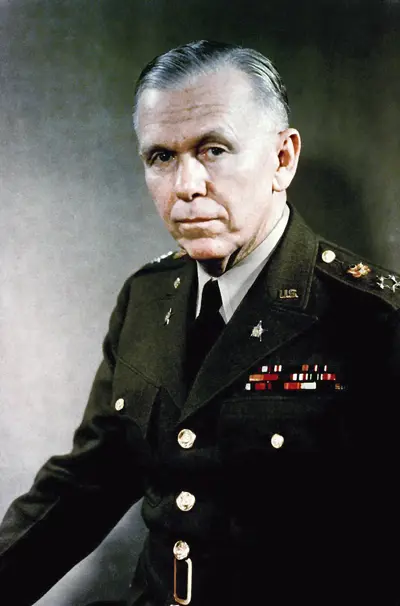
George Catlett Marshall Jr. was an American soldier and statesman. He rose through the United States Army to become Chief of Staff under presidents Franklin D. Roosevelt and Harry S. Truman, then served as Secretary of State and Secretary of Defense under Truman. Winston Churchill lauded Marshall as the "organizer of victory" for his leadership of the Allied victory in World War II. After the war, he spent a frustrating year trying and failing to avoid the impending civil war in China. As Secretary of State, Marshall advocated a U.S. economic and political commitment to post-war European recovery, including the Marshall Plan that bore his name. In recognition of this work, he was awarded the Nobel Peace Prize in 1953.
