Peter Singer Quotes
Take for example providing a guide dog for a blind person. That's a good thing to do, right? All right. It is a good thing to do. But you have to think what else you could do with the resources. It costs about $40,000 to train a guide dog and train the recipient so that the guide dog can be an effective help to a blind person. It costs somewhere between 20 and $50 to cure a blind person in a developing country if they have trachoma. So you do the sums, and you could provide one guide dog for one blind American or you could cure between 400 and 2,000 people of blindness.
Singer, Peter. "The why and how of effective altruism." TED, Mar. 2013.


Whether or not our USAID officials are tough on a bureaucracy or a government unfortunately has had little to do with whether they had used to money for services to the poor, but how the nation voted in support of the United States in the UN and engaged in other political acts perceived by the State Department and the Administration to be favorable to the United States.


"He" referred to William Clinton. At the time the Clinton Foundation which had been one of the major world factors in providing needed funds to lesser developed counties for humanitarian and development projects, was being viciously attacked by many of the Tea Party and Right Wing Republicans.


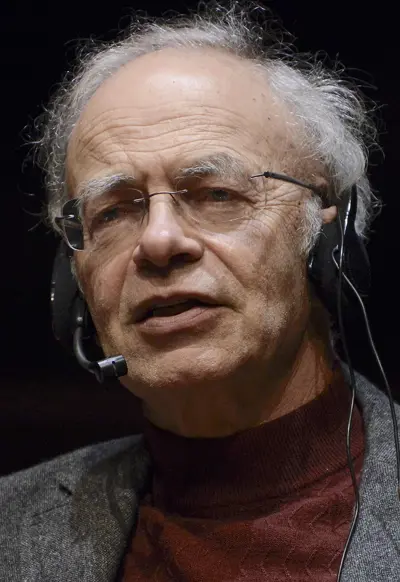
Peter Albert David Singer AC is an Australian moral philosopher, currently the Ira W. DeCamp Professor of Bioethics at Princeton University. He specialises in applied ethics and approaches ethical issues from a secular, utilitarian perspective. He is known in particular for his book Animal Liberation (1975), in which he argues in favour of veganism, and his essay "Famine, Affluence, and Morality", in which he argues in favour of donating to help the global poor. For most of his career, he was a preference utilitarian, but he stated in The Point of View of the Universe (2014), coauthored with Katarzyna de Lazari-Radek, that he had become a hedonistic utilitarian.
