Richard P. Feynman Quotes
So close is life to life. The universality of the deep chemistry of living things is indeed a fantastic and beautiful thing. And all the time we human beings have been too proud to recognize our kinship with the animals.
"The Uncertainty of Science", John Danz Lecture Series, 1963
Sourced by: Eigen's Political and Historical Quotations


The school board had been pressured by religious fundamentalists throughout the state of Georgia to affix these stickers to all textbooks as there were no textbooks that met curricular standards that did not teach evolution. As soon as they started this practice, a suit was filed in the Federal District Court which found the practice violated both the Federal and Georgia State Constitutions ({586989}). The only reason that the stickers had been used was to try and placate those religious fundamentalists of the community who were opposed to the teaching of evolution. See {586968} for a quote from the legal opinion.


The Bible contains two separate and somewhat contradictory versions of creation (Adam & Eve vs. the 6 day creation).

While Darwin’s Theory of Evolution was rejected as heresy by many Christians, there were others who warmly embraced it, and frequently lectured on the subject. Drummond was one of the Christian theologians who saw evolution as the real Genesis. See {611095}.

Actually, The Theory of Evolution shows no such thing. Diversity is critical for Natural Selection to function. It is the inbred Royalty of Europe that showed a propensity to various defects and abnormalities. There are millions of examples where the offspring of a couple are superior to both parents with respect to a characteristic. Some also who are inferior to both parents. Then there are some “in-between”. Traits in evolution and generics are not subject to a simple averaging.

The Science Guy


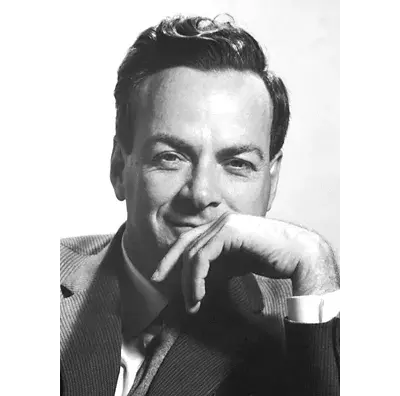
Richard Phillips Feynman was an American theoretical physicist and Nobel Prize winner who made significant contributions to quantum mechanics, quantum electrodynamics, and particle physics. He's known for his work on the Manhattan Project, developing Feynman diagrams, and explaining the interactions between light and matter. While studying for his PhD, Feynman participated in the Manhattan Project and helped develop the atomic bomb. For contributions to the development of quantum electrodynamics, Feynman received the Nobel Prize in Physics in 1965 jointly with Julian Schwinger and Shin'ichirō Tomonaga.
