Ibn Khaldun Quotes
Religious propaganda gives a dynasty at its beginning another power in addition to that of the group feeling it possessed as the result of the number of its supporters... This happened to the Arabs at the beginning of Islam during the Muslim conquests
He was one of the world’s greatest polymaths who among his other accomplishments was the “Father of Sociology” and was the leading Islamic intellectual of his era.
Ibn Khaldun, 1332-1406, Tunisian Islamic astronomer, economist, historian, Islamic jurist, Islamic lawyer, Islamic scholar, Islamic theologian, mathematician, military strategist, nutritionist, philosopher, social scientist and statesman, Muqaddimah
Sourced by: Eigen's Political and Historical Quotations

While Perez describes the situation accurately, he does not mention here that there is a minority of fundamentalist Jewish Israelis, and they too do not make compromises easily. Nor do the Christian fundamentalists in the United States. All say, “How do you compromise with the will of God.”


This is a very important quotation as it focused on one critical difference between historical Islam and all the other major religions and fundamentally on the separation between church and state. In Islam there was a Caliph who was both the political ruler and the religious ruler. In comparison at the time, the Christians had a Holy Roman Emperor who was theoretically the overlord of all the Christian Kings but in reality he really could not exercise total or even much authority over all the other kings. At the same time, there was the Pope who was the religious leader of all the Christians. Since the distinction between Church and state was constantly in flux, the Christian Pope and Holy Roman Emperor were often at odds. The third Abrahamic religion, Judaism, had neither a secular leader or a religious one and no hierarchy other than local. Khaldun observed the theoretical advantage of Theocracy as a model, however he did not analyze the disadvantages among which were the assassination of many Caliphs and the laces. Even the Muslim Arabic states abandoned the idea of a Caliph in modern times until Iran adopted a Theocracy with a single Leader all powerful. However, all the other Arab nations wanted no part of a singular leader for all Muslim nations or even a single civil and religious leader within any other country. Al Qaeda however claimed to be fighting for a return to a Caliphate not only for the current Islamic Nations but for all nations which must be subservient to Islam.


While this view is shared today by many fundamentalist Muslims, the exact same argument has been made in the past and is currently made by some fundamentalist Christians and ultra Orthodox Jews.

Bashir advocates adapting Sharia—Islamic Law—for all people in Indonesia—regardless of their religion or their preference for separation of church and state. This is diametrically opposite to an Islamic Syrian poet of 1000 years ago—see {624477}. Many Muslims have become more intolerant than some of their earlier scholars. Bashir also differs from most Indonesian Muslims who have historically not shared his bigotry and intolerance.
Al-Maarri’s quotations are not only meaningful in their own right, but they illustrate the openness and free thinking that was allowed in the early days of Islam before about 1100. If anyone wrote such things today in most Islamic countries he would at least be jailed if not executed for blasphemy. And if any Christian in Europe made the same statement, he would have been excommunicated at least if not tortured and murdered.

He repudiated all cases in which a Muslim sold land to a non-Muslim, even though in the Holy Land, Christians, Jews and Muslims have been buying and selling land there to each other for centuries. This has been going on from the time of Christ for the Christians and Jews, and the Muslims from the time of the founding of Islam in the 7th Century. Even Caliph Omar, the authority he cited, allowed and recognized sales of land to Christians and Jews and purchases from them. Rantisi and his followers have actually killed Palestinians who have sold land to Jews.


This Arab nationalist leader was actually a Christian Orthodox by religion. He also tried to make the Baath party a secular state and he was a strong advocate of free speech and democracy. When the Islamic fundamentalists became important in Mid East Politics, the Baath Iraq Government under Saddam Hussein claimed, with no evidence, that Aflaq converted to Islam on his deathbed, thus making his philosophy more acceptable to the vast majority of Arabs.
Hizb ut-Tahrir is a “worldwide Islamic political party.” It is banned as a terrorist, violence provoking institution in most of the Muslim countries and many nations in Europe.

Bangladesh had fared very poorly as a part of Pakistan. When it revolted and became independent, it adopted a secular government whereas Pakistan had been, and is, a heavily Islamic state. However, the vast majority of Bengalis were Muslim and some were extreme fundamentalists. Rahman was under constant pressure to make the government more “Islamic” and while he did so somewhat, he tried to advocate for separation of church and state. Bangladesh is not as extreme as Pakistan which is not yet a theocracy but religious forces dominate every aspect of the society.

While the vast majority of Muslims had little or no thought of Islam ruling or even dominating the non-Muslim part of the world. But of the minority of the Islamic Religious Extremists, most saw a struggle with the Christians, Jews, and other religions of the world until Islam ruled the world—an outcome which most saw as inevitable.

He is a Greek Orthodox Christian, and he correctly observes that the Islamic world was considerably more tolerant than the Christian until the 18th century when Islam had become less tolerant in the Middle East while the Christians were modernizing and going through a cultural and intellectual enlightenment and societal modernization while the Muslims, became less tolerant than they were in earlier years leading to the modern situation.

Historically, this quotation shows that the negative relationship between the West and Islam and negative views of Islam was not a new phenomenon at the beginning of the 21st century. It existed long before, and as with the 21st century concerns, violence and war were the major concerns.

Some people read this part of the declaration as saying that if Muslims are in the majority and control the nation, there is no problem with violence. But if the Muslims are in the minority, they will likely be violent. Needless to say, this alarms most Western nations.
Damn this world, Damn this time. Damn this fate That uncivilized Arabs have come to make me a Moslem
This is a huge epic poem that he wrote over several years. At the time, the Persians considered themselves far more civilized and sophisticated than the Arabs who were but tribesmen. They really resented the fact that it was the Arabs that brought Islam. And before, most of the Persians worshipped Zoroaster. Although Islam spread faster and further than any religion in history, it was not always easily accepted as this stanza of the poem indicates. There is to this day a superiority that the Iranians perceive over the Arabs. And to this day, many Arabs resent the Iranians for this attitude.


This is an interesting quotation as it shows that there were opponents of literal interpretation of the Bible in the 17th century, and that they were among the leading men of the day. The argument that the Bible has divine inspiration but was written by men and should not be taken literally, has been made since the Ancient Jews received the Bible.
The writer was born and brought up a Muslim and because he criticizes Islam, he has had a death fatwa issued against him much like Salman Rushdie. His prediction was one of the earliest warnings


This was one of the sagest pieces advice regarding Islam given in the early 20th century.
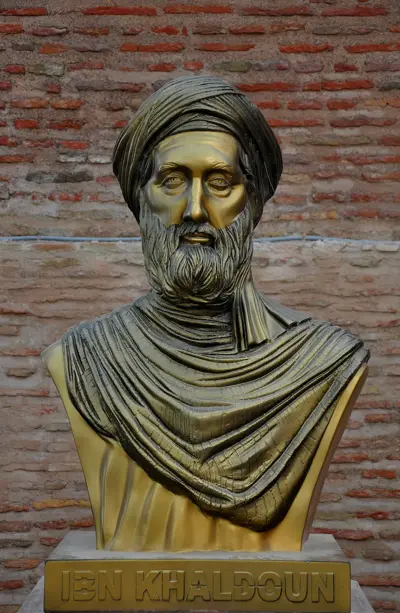
Ibn Khaldun was an Arab sociologist, philosopher and historian who has been described as the founder of the modern disciplines of historiography, sociology, economics, and demography. Niccolò Machiavelli of the Renaissance and the 19th-century European scholars widely acknowledged the significance of his works and considered Ibn Khaldun to be one of the greatest philosophers of the Middle Ages.
