Evelyn Baring Quotes
Persians, Greeks, Romans, Arabs from Arabia and Baghdad, Circassians, and finally, Ottoman Turks, have successively ruled over Egypt, but we have to go back to the doubtful and obscure precedents of Pharaonic times to find an epoch when, possibly, Egypt was ruled by Egyptians. Neither, for the present, do they appear to possess the qualities which would render it desirable, either in their own interests, or in those of the civilized world in general, to raise them at a bound to the category of autonomous rulers with full rights of internal sovereignty.
Earl of Cromer
Evelyn Baring, 1841-1917, British Governor General of Egypt, Why Britain Acquired Egypt in 1882, 1908
Sourced by: Eigen's Political and Historical Quotations


This newspaper was an English language organ published by General Allenby’s British and Allied forces in the Middle East. Prior to the war, the Middle East was all part of the Ottoman Empire. However, the Ottoman Turks sided with Germany in WWI and their Middle East dominions were targets for the allied military strategy.


This Proclamation was issued upon arrival of the British occupying imperial army in present day Iraq. The English policy makers like the Bush administration almost a century later were expecting a more welcoming reaction. See {585250}.


Czechoslovakia resembles America because


The Arabs have a long history of arrogant and disdainful treatment by others given the British Colonial history in the Middle East, the French (who invaded Egypt under Napoleon), the Islamic Ottoman Empire which controlled the Middle East before that, and others. Along with the arrogance that usually comes with empire, Western support of the only democracy and modern state in the Middle East—Israel—was even more resented by the Arabs. Historically, there was a general feeling by much of the world that if the Arabs had no oil, no one would pay much attention to them. The Arabs naturally resented these attitudes. It was not until Nasser’s successor, Anwar Sedat, came to government in Egypt and King Hussein reformed Jordan, that Western attitudes began to change towards the Arab nations. The Western change was not because of any Arab “lesson” but the result of new, exceptionally capable leaders who have been reforming the Arab nations.

The Ottoman Turks, at war with Russia, exterminated a large proportion of the Armenian population of the then Turkish Empire. Some of the ethnic Armenians were working with Armenians in greater Russia and thus were a risk to the Turks. However, they starved, shot, beat, hung, and bayoneted hundreds of thousands of ethnic Armenians, wiping out entire villages and towns. Despite the fact that women and little children were all killed, Modern Turkey even into the 21st century refused to admit that this was a genocide even though there was ample documentation to prove it was not spontaneous but government ordered by the “Young Turks” then controlling Turkey. See {620603} and {612638} for examples. The modern Turks maintain the view expressed during the genocide that Armenians were a threat to Turkish Independence.

Greece had always coveted Anatolia which was a part of the Ottoman Empire but had been in antiquity a Greek dominated area. Further, people of Greek ethnicity and culture, who hundreds of years ago use to be the vast majority were after the hundreds of years of Ottoman rule and migration were then the largest minority in Anatolia. After the Turks lost the First World War as a consequence of their allying with Germany, and had been stripped of its Arab territories and was determined to keep the territories that they still had. Also, Turkey had just undergone a revolution and the old order was displaced. Venizelos and the Greeks saw this as an opportunity to get back Anatolia and sent a military invasion force to land at Smyrna (Ismir to the Turks), the largest city of Anatolia where despite the Greek minority in all of Anatolia, Greeks were a small majority in Smyrna and many of the ethnic Greeks not only aided the Greeks once they had landed but participated in atrocities against the minority of Turkish Muslims of Smyrna. The Ambassador was then trying to rationalize the heavy hand with which the Turks dealt with the indigenous Greeks many of whom were guilty and many of whom were not.


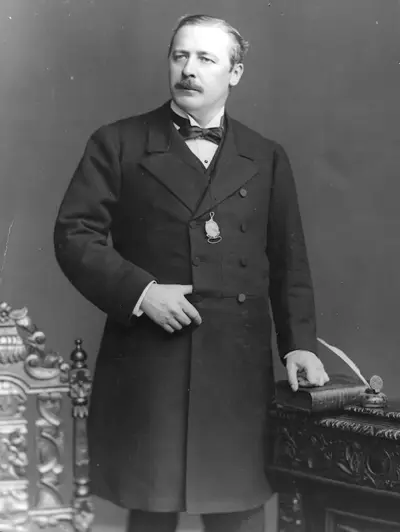
Evelyn Baring, 1st Earl of Cromer, GCB, OM, GCMG, KCSI, CIE, PC, FRS was a British statesman, diplomat and colonial administrator. He served as the British controller-general in Egypt during 1879, part of the international control which oversaw Egyptian finances after the Egyptian bankruptcy of 1876. He later became the agent and consul-general in Egypt from 1883 to 1907 during the British occupation, prompted by the Urabi revolt. This position gave Baring de facto control over Egyptian finances and governance.
