Alexander Pope Quotes
One science only will one genius fit; so vast is art, so narrow human wit.
Pope, Alexander. An Essay on Criticism. W. Lewis, 1711, p. 7.


The problem effects politics in that politicians and their staffs who have to understand critical concepts cannot even read up on the subject very deeply unless they have experience with the technical vocabulary of the specific field. The result is that are dependent on experts and are unable to reach conclusions for themselves.


This was in 1945 where the number of research studies published each month was large compared to the past but a tiny fraction of what it would be just 50 years later.

Bush had advised FDR to go ahead with the research and development program to try and develop an atomic bomb. He was the only Government Official who Roosevelt discussed the idea with. At the time, Bush as a government official supervised and directed many thousands of scientists, and was one of just a few scientists who monitored and advised on the Manhattan Project to develop the Bomb. Here he is one of the first people to notice, understand and articulate the dilemma of specialization in science. To the degree it was a problem in 1945, it became a geometrically greater problem 65 years later satellites were capturing more high resolution of the universe every week than all the astronomers in the world could examine in a year. Ironically, Bush called for a type of precursor to the Internet to cope with this problem which the Internet helped with. Using computers to observe and analyze the many images helped much but all of science became weighed down with this problem of specialization and the explosion of knowledge.


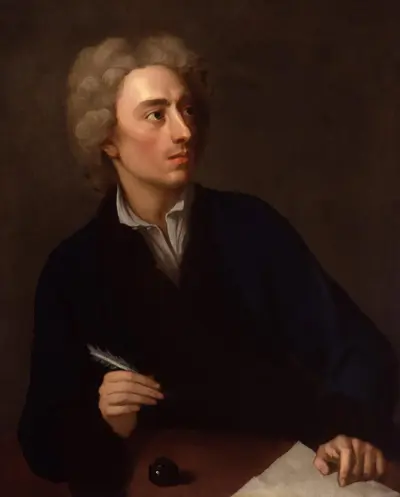
Alexander Pope is seen as one of the greatest English poets and the foremost poet of the early 18th century. He is best known for satirical and discursive poetry, including The Rape of the Lock, The Dunciad, and An Essay on Criticism, and for his translation of Homer. After Shakespeare, Pope is the second-most quoted writer in English, according to The Oxford Dictionary of Quotations, some of his verses having become popular in common parlance (e. g., damning with faint praise). He is considered a master of the heroic couplet.
