Stokely Carmichael Quotes
Now, then, in order to understand white supremacy we must dismiss the fallacious notion that white people can give anybody their freedom.
Carmichael, Stokely. "Black Power." University of California, Berkeley, 29 Oct. 1966, Berkeley, CA. Speech.


Historically, until recently there has been a migration from the South to other parts of the country. After legal segregation ended, the out migration slowed and by the end of the 20th century, people—including intellectuals began moving to the South. Generally, the vestiges of the anti intellectualism began to fade, but even into the 21st century the College Board Test Scores and other educational measures were generally lower in the South than in the rest of the country. Ironically, whereas the Southern insistence on segregated schools was to prevent the intellectual erosion that racists thought would come with integration, the educational achievement of the schools and population of the less segregated school areas was considerably better. With legal segregation, there were very few high quality universities in the South and no “World Class” schools. However, along with desegregation has been the intellectual and academic improvement of the Southern Schools and the South began to have, for the first time in America, some educational institutions that were on a par with the rest of the country. The South paid a heavy price for segregation and insularity.

Under the previous Republican administrations, virulent and overt racists were not generally appointed especially as they were generally then Democrats. However, when Woodrow Wilson was elected president, he not only appointed many overt racists but he himself may have been one of the most racist Presidents every to inhabit the white House. He fired almost all the Blacks who held positions in the Federal government.

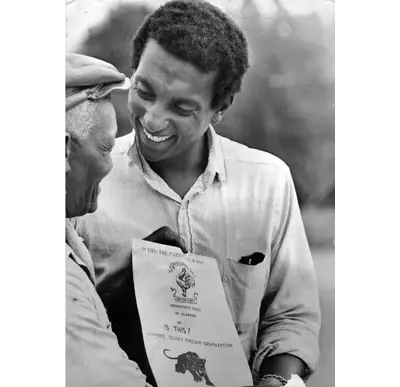
Kwame Ture was a prominent organizer in the civil rights movement in the United States and the global Pan-African movement. Born in Trinidad, he grew up in the United States from the age of 11 and became an activist while attending the Bronx High School of Science. He was a key leader in the development of the Black Power movement, first while leading the Student Nonviolent Coordinating Committee (SNCC), then as the "Honorary Prime Minister" of the Black Panther Party (BPP), and last as a leader of the All-African People's Revolutionary Party (A-APRP).
