Roger Bacon Quotes
Neglect of mathematics work injury to all knowledge, since he who is ignorant of it cannot know the other sciences or things of this world. And what is worst, those who are thus ignorant are unable to perceive their own ignorance, and so do not seek a remedy.
Bacon, Roger. The Opus Majus of Roger Bacon. Translated by Robert Belle Burke, vol. 1, University of Pennsylvania Press, 1928, p. 116.

An earlier variant of this quotation was made by the Harvard University President, Derek Bok {634685}.


Snow was one of the first people to call attention to problem of the intellectual gulf between most educated people and scientists. As politicians generally fall into the former group, they have had a particularly difficult time dealing with scientific issues since the scientific revolution of the 20th century produced this cultural chasm. See {635974} for one of his conclusions.


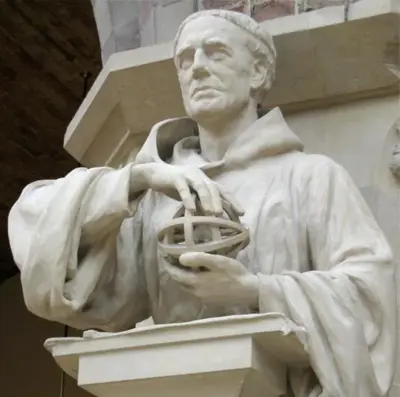
Roger Bacon (/ˈbeɪkən/; Latin: Rogerus or Rogerius Baconus, Baconis, also Frater Rogerus; c. 1219/20 – c. 1292), also known by the scholastic accolade Doctor Mirabilis, was a medieval English philosopher and Franciscan friar who placed considerable emphasis on the study of nature through empiricism. In the early modern era, he was regarded as a wizard and particularly famed for the story of his mechanical or necromantic brazen head. He is sometimes credited (mainly since the 19th century) as one of the earliest European advocates of the modern scientific method. Bacon applied the empirical method of Ibn al-Haytham (Alhazen) to observations in texts attributed to Aristotle. Bacon discovered the importance of empirical testing when the results he obtained were different than those that would have been predicted by Aristotle.
