John Donne Quotes
Nature hath no goal though she hath law.
Donne, John. "Elegie XVII: Variety." The Poems of John Donne, edited by Herbert J. C. Grierson, vol. 1, Oxford University Press, 1912, p. 115.


This quotation was from a mathematician who was in the midst of the expansion of mathematics in the late 19th century to include the then rapid and rich development of Probability. This required mathematicians, scientists and others who would use the new mathematics to think in a very different way. For the existing mathematicians his quote clearly states the dilemma for them. Today, scientists and mathematicians have little trouble with “laws of probability” and realize that Probability is governed and controlled in the same way as other fields of mathematics; they are comfortable with different results occurring under the exact same experimental conditions, and those different results are unpredictable in any particular instance, but exactly predictable in terms of frequency of each possible occurrence. This makes Quantum Mechanics rational. However, few non scientists have had their thinking expanded and are comfortable with this thinking. Law and public policy makers are particularly vexed by not being able to think and work in this paradigm where consequences of something can be described for a population precisely, and yet be impossible to describe for any particular individual. This will improve over time, as politicians and other community leaders become better educated mathematically and scientifically.

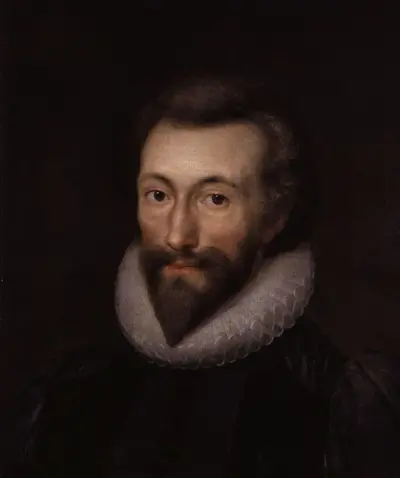
John Donne was an English poet, scholar, soldier and secretary born into a recusant family, who later became a cleric in the Church of England. Under royal patronage, he was made Dean of St Paul's Cathedral in London (1621–1631). He is considered the preeminent representative of the metaphysical poets. His poetical works are noted for their metaphorical and sensual style and include sonnets, love poems, religious poems, Latin translations, epigrams, elegies, songs, and satires. He is also known for his sermons.
