Alfred Rosenberg Quotes
National Socialism stands or falls by its Weltanschauung.
Rosenberg, Alfred. The Myth of the Twentieth Century: An Evaluation of the Spiritual-Intellectual Confrontation of Our Age. Translated by Vivian Bird, Noontide Press, 1982, p. 433.


The Russian troops had surrounded Berlin and were closing on the bunker. Hitler announced that he intended to commit suicide. 8 days later he did.
Within a few years the National Socialists of Germany had invaded most of the countries of Europe. The protestations of non aggressive intent have historically meant nothing whether it was the promises of Napoleon, Hitler or that of Hamas.


This was the origin of the ultra right wing British Fascistic.

The Christian Front was one of the network of Fascist organizations established and controlled by “radio priest” Charles E. Coughlin. In 1940 investigative reporter Lawrence Spivak did an expose of the Christian Front and The FBI raided its offices and confiscated many weapons intended for the assassination of people including a dozen members of Congress. See {588482}.


In 1918 the Treaty of Versailles—peace treaty ending WWI—was signed. Many Germans felt that their defeat in WWI forced them to sign the treaty which weakened Germany and assured that they would be a 2nd rate power thereafter. After that Germans blamed every negative aspect of their government, economy and society on the treaty that was “forced” on them. Nazism was a consequence of these feelings, and the Nazis adopted policies and practices to get around their anti-military obligations and have a strong government so that the allies could not enforce the treaty obligations on Germany.


See Huey Long for a similar point of view.


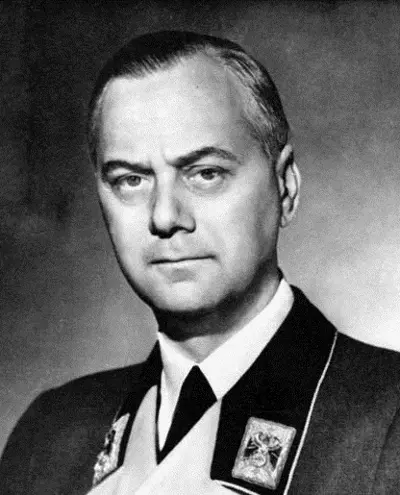
Alfred Ernst Rosenberg was a Baltic German Nazi theorist and ideologue. Rosenberg was first introduced to Adolf Hitler by Dietrich Eckart and held several important posts in the Nazi government. He was the head of the NSDAP Office of Foreign Affairs during the entire rule of Nazi Germany (1933–1945), and led Amt Rosenberg ("Rosenberg's bureau"), an official Nazi body for cultural policy and surveillance, between 1934 and 1945. During World War II, Rosenberg was the head of the Reich Ministry for the Occupied Eastern Territories (1941–1945). After the war, he was convicted of crimes against peace; planning, initiating and waging wars of aggression; war crimes; and crimes against humanity at the Nuremberg trials in 1946. He was sentenced to death and executed on 16 October 1946.
