Epicurus Quotes
Moreover, the universe as a whole is infinite, for whatever is limited has an outermost edge to limit it, and such an edge is defined by something beyond. Since the universe has no edge, it has no limit; and since it lacks a limit, it is infinite and unbounded. Moreover, the universe is infinite both in the number of its atoms and in the extent of its void.
Epicurus. "Letter to Herodotus." Letters, Principal Doctrines, and Vatican Sayings, translated by Russel M. Geer, Bobbs-Merrill, 1964, p. 19.


Greece claims him, but he was born and worked in Asia Minor in what is now Turkey. He was right on and our civilization did not realize that he was correct until 2,000 years later. And we keep discovering smaller and smaller parts.


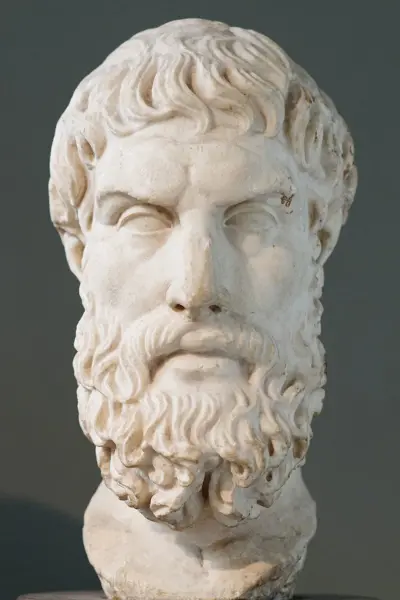
Epicurus (Ancient Greek: Ἐπίκουρος, romanized: Epíkouros; 341–270 BC) was an ancient Greek philosopher and sage who founded Epicureanism, a highly influential school of philosophy. He was born on the Greek island of Samos to Athenian parents. Influenced by Democritus, Aristippus, Pyrrho, and possibly the Cynics, he turned against the Platonism of his day and established his own school, known as "the Garden", in Athens. Epicurus and his followers were known for eating simple meals and discussing a wide range of philosophical subjects. He openly allowed women and slaves to join the school as a matter of policy. Epicurus is said to have originally written over 300 works on various subjects, but the vast majority of these writings have been lost. Only three letters written by him—the letters to Menoeceus, Pythocles, and Herodotus—and two collections of quotes—the Principal Doctrines and the Vatican Sayings—have survived intact, along with a few fragments of his other writings. Most knowledge of his teachings comes from later authors, particularly the biographer Diogenes Laërtius, the Epicurean Roman poet Lucretius and the Epicurean philosopher Philodemus, and with hostile but largely accurate accounts by the Pyrrhonist philosopher Sextus Empiricus, and the Academic Skeptic and statesman Cicero.
