Ismail Serageldin Quotes
Many of the wars this century were about oil, but those of the next century will be over water
Water has always been in short supply in the Middle East. For thousands of years in the past water rights and possession was the cause of many conflicts. The rapid increase in fertility and population in the Muslim countries of the Middle East has placed even more stress on the water supply while waste is common. Fortunately Israel and Turkey have developed many techniques of using water efficiently. However, the rest of the Middle Eastern nations are slow to adopt these methods of water conservation, water generation and production, and agriculture that requires much less water than in the past. Politics, religion, and culture can be barriers or facilitators.
Ismail Serageldin, World Bank Vice President for Environmental Affairs, Egyptian Director of the Alexandrian Library, Member of the Egyptian Senate, Interview with Newsweek, 1995
Sourced by: Eigen's Political and Historical Quotations


First Mormon Cabinet Member. The water problem did not come upon us suddenly.

Even before the drought the California (and other Western States’) water distribution system has been unfair, inefficient, wasteful, and irrational. There is only so much to go around and the demand it greater. Farmers sometimes pay only 1 percent of the cost the state incurs for the water they us. And far less than poor city or suburban dwellers. Few California farmers use the efficient drip irrigation system developed in Israel. Some farmers get most of the water they want while others get nothing. The taxpayers in the rest of the country pay for the California cheap water while they themselves pay many times the cost of the water. Ironically, Conservatives who almost always want market based solutions oppose it in the case of water as then the large corporate farms would not have the huge water subsidy that they have now.
The nest year California Governor Jerry Brown imposed a form of water rationing.
Agriculture, in most of the country, uses much more water than the human population does for personal drinking and hygiene, but in a number of places there is just not enough water to support all the uses in our growing nation. Agriculture has been organized and has been willing to spend large amounts of money to bribe and/or lobby legislators to block many efforts to develop water supplies for cities large and small under the theory that the more water that went to cities, the less there would be for agriculture.


1700 scientists, including the majority of the American Nobel Prize Winners in Science, personally signed this 1992 warning about the environment.


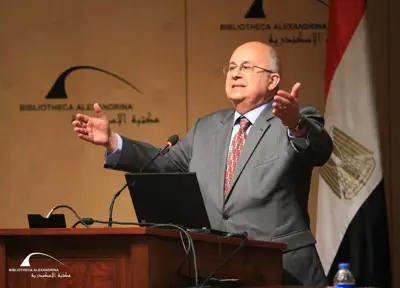
Ismail Serageldin (/ˈsɛrəɡɛldɪn/; born 1944 in Giza, Egypt), Founding Director of the Bibliotheca Alexandrina (BA), the new Library of Alexandria, inaugurated in 2002, is currently, Emeritus Librarian, and member of the Board of Trustees of the Library of Alexandria. He serves as Chair or Member of a number of advisory committees for academic, research, scientific and international institutions and civil society efforts, including as co-Chair of the Nizami Ganjavi International Center (NGIC), and serves on the Advisory Committee of the World Social Science Report for 2013 and 2016, as well as the UNESCO-supported World Water Scenarios (2013) and the executive council of the Encyclopedia of Life (2010) and Chairs the Executive Council of the World Digital Library (2010). He also co-chaired the African Union's high level panel for Biotechnology (2006) and again for Science, Technology and Innovation (STI) in 2012–2013, and was a member of the ICANN Panel for the review of the internet future (2013).
