Ruth Bader Ginsburg Quotes
Judges should avoid commenting on a candidate for public office.
Ginsburg, Ruth Bader. "Statement from Justice Ruth Bader Ginsburg." Supreme Court of the United States, 14 July 2016.

Hughes constantly allowed that it was improper for a sitting Supreme Court justice to be a candidate for the Presidency. But the Republican Party was badly split between the progressives and the conservatives. Each likely candidate had been on one side or the other, and was therefore unacceptable to the wing he had not supported. Hughes was one of the few Republicans who did not take sides in the 1912 schism as he was a member of the Supreme Court. His neutrality and his absence of any political statements in recent years made him a very attractive Presidential Nominee for Republicans. But his luster would wear off quickly if he let the Republicans know how he stood on any of the issues splitting the party. The only way that he could avoid saying anything was to maintain that he was not and should not be a candidate. Therefore he was nominated. However, to avoid losing one of the wings of his party, he had to essentially take a position on very few issues in the 1916 campaign. He just criticized President Woodrow Wilson and the Democrats. See {642634} for how the Wilson forces turned his avoidance of issues to their advantage.


In the 2000 Presidential Election, Gore won the popular vote, but the electoral votes were so close that the winner depended on a single state, Florida. However, that state’s election process was poor and there were many irregularities and problems in vote counting and recounting. The Republican Secretary of State stated that the Republican candidate won, but the irregularities persuaded the Florida Supreme Court to order a recount. That decision was appealed to the Supreme Court which decided to stop the recount, giving the Presidency to Bush. All nine Supreme Court Justices were unhappy that they had to decide a case which determined who the President would be, but if they had refused to hear the case, the raw politics of Florida would determine the President. Stevens wrote this quotation in his dissent, and ironically it was about the only thing that the nine justices all agreed to—that the nation’s confidence in the Supreme Court and the legal system was the loser. There was no way for the court to win, unless they could have mustered an overwhelming majority for one side or the other. That proved impossible, so all the justices tried to make the best of a bad situation in which they had been placed.


Scalia had been a close friend of the Vice President. He had recently been taken on the Vice President’s plane and they went duck hunting.


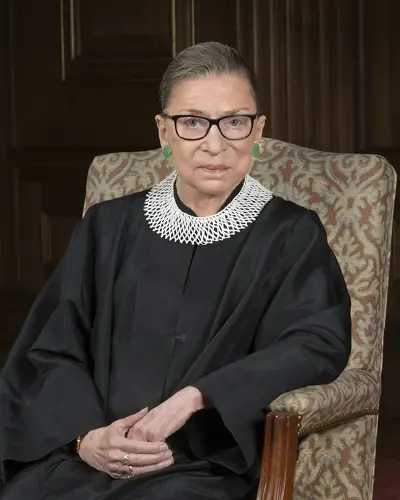
Joan Ruth Bader Ginsburg was an American lawyer and jurist who served as an associate justice of the Supreme Court of the United States from 1993 until her death in September 2020. She was nominated by President Bill Clinton, replacing retiring justice Byron White, and at the time was generally viewed as a moderate consensus-builder. She eventually became part of the liberal wing of the Court as the Court shifted to the right over time. Ginsburg was the first Jewish woman and the second woman to serve on the Court, after Sandra Day O'Connor. During her tenure, Ginsburg wrote notable majority opinions, including United States v. Virginia (1996), Olmstead v. L.C. (1999), Friends of the Earth, Inc. v. Laidlaw Environmental Services, Inc. (2000), and City of Sherrill v. Oneida Indian Nation of New York (2005).
