Agesilaus II Quotes
It is not the places which grace men, but men the places.
See {632269} for a later Scottish quotation on this principle.
Agesilaus II, 444 BC-360 BC, Spartan King, Statement when asked by a visitor at a Spartan event, why he was not seated in a special place of honor, Quoted in Plutarch: Lives
Sourced by: Eigen's Political and Historical Quotations

Although born a noble, he was very informal and at his dinners and banquets he sat in different places at the table and not at the traditional head. When asked why, this was his reply. See {632267} for an early Spartan similar view.


Leo the Great. Saint Peter was the first head of the Catholic Church—the Pope. Pope Leo observed that the Papacy and the church itself is not permanently diminished just because a particular pope is corrupt or unworthy. This is a principle that has been accepted by most governments regarding their heads of state. A particular bad President for example, does not mean the Presidency is bad.


His army had been so successful that many of his men had all the riches they ever dreamed of and great glory as well. Some just wanted to slow down and enjoy the conquered lands where they had been received very cordially as Alexander’s “occupation” was much more benign than the Asian rulers had been. So some of Alexander’s men were critical of Alexander and in effect, Alexander said that the complaints are what a successful king should expect after so much success and popularity. This quotation was inscribed in Latin on the town-hall of Zittau, in Saxony during the reign of Frederick The Great. Politicians have been comforted by Alexander’s quotation even to modern times. Also, see {632232} for Voltaire’s version of Alexander’s statement.


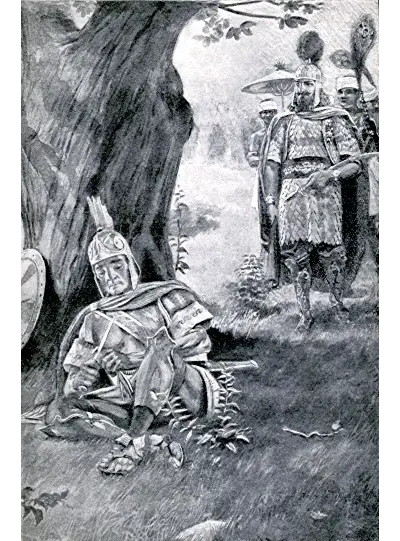
Agesilaus II (/əˌdʒɛsəˈleɪəs/; Greek: Ἀγησίλαος Agesilaos; c. 444/443 – c. 360 BC), was a king (basileus) of the ancient Greek city-state of Sparta and a member of the Eurypontid dynasty ruling from 398 to about 360 BC usually, in Plutarch's words, "as good as though commander and king of all Greece" and was for the whole of it greatly identified with his country's deeds and fortunes. Small in stature and lame from birth, Agesilaus became ruler somewhat unexpectedly in his mid-forties. His reign saw successful military incursions into various states in Asia Minor, as well as successes in the Corinthian War, but several diplomatic decisions resulted in Sparta becoming increasingly isolated prior to his death at the age of 84 in Cyrenaica.
