John Paul Stevens Quotes
It is not our job to apply laws that have not yet been written.
Stevens, John Paul. Sony Corp. of America v. Universal City Studios, Inc., 464 U.S. 417, Supreme Court of the United States, 17 Jan. 1984, p. 456.


This concept of balance of power and the equal role of the judiciary is actually quite rare. Even in Parliamentary democracies the parliament can override any court interpretation. In England, the upper legislative house, the House of Lords, actually serves as the nation’s highest or supreme court. And these “Law Lords” can override all regular judicial bodies.

In a celebrated case involving the right of the U. S. House of Representatives' Un-American Activities Committee to "expose" someone as a Communist, Mr. Justice Brennan wrote:

At the time, Spain was one of the most backward countries in Europe. They were still executing people for heresy and blasphemy.


In modern times almost all countries have written constitutions. And almost all of those constitutions appear to be democratic. Many have been taken from the United States Constitution. However, most of the countries are not real democracies as they do not enforce their own constitutions. For example, in Egypt, the constitution guarantees women equal rights to men. There are many female attorneys. However, the notion of a female judge is too much for the sexist culture. So regardless of what the constitution says, it is not enforced with respect to female judges. When Smyth gave his lecture, constitutions were just getting popular. He was prescient enough to realize that a constitution to be effective must conform to the belief structure of most of the population and the constitution most be administered as well as written.


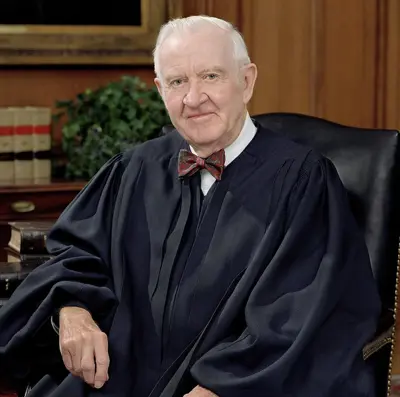
John Paul Stevens was an American lawyer and jurist who served as an associate justice of the United States Supreme Court from 1975 until his voluntary retirement in 2010. At the time of his retirement, he was the second-oldest-serving justice in the history of the court and the third-longest-serving justice. At the time of his death, he was the longest lived Supreme Court justice ever. His long tenure saw him write for the court on most issues of American law, including civil liberties, death penalty, government action and intellectual property. In cases involving presidents of the United States, he wrote for the court that they were to be held accountable under American law. A registered Republican when appointed who throughout his life identified as a conservative, Stevens was considered to have been on the liberal side of the court at the time of his retirement.
