George Carey Quotes
Is it possible to have a grown-up debate about the failings of Islam, Christianity and Judaism? And how do you offer criticisms of Islam in particular without appearing - however unintentionally - to back up some very nasty stereotypes and prejudices?
George Carey, Archbishop of Canterbury [Anglican Church], Interview, BBC Newsnight, March 29, 2004
Sourced by: Eigen's Political and Historical Quotations


Toleration is a relative term. The Muslim Moors made Christians (and Jews) pay a special tax. At times they were forced to wear special clothing so that they could be readily identified. And they could not build churches larger or taller than the smallest mosque in the community. At times, their occupations were restricted but at other times Christians and Jews were appointed to the highest positions like Vizier. The Inquisition, in contrast, forced all Muslims (and Jews) to leave the country without any of their property or money or be tortured and killed—usually by burning at the stake unless of course that they converted to Christianity.


One remarkable aspect of this quote is that most Western nations have the exact same perception he claims the Islamic word does of what the West is doing. While the Western nations think the defense is necessary and desirable, the Muslim nations fundamentally believe that Christianity and Judaism should and will be supplanted by Islam. To the Islamic fundamentalist religion is a zero sum game. Every person in the world who is not a Muslim is an attack on Islam in that God wants all to follow Islam and wants the faithful to make it so.


See {586039} for a quotation that goes further and seeks to punish and humiliate the non believers. This sura is often used by those wishing to illustrate the intolerance of Islam—especially of other religions. They fail to put this into the context of the Old Testament which proscribed death for heretics or the history of Christianity regarding the murder of nonbelievers. The difference is however, that a very small proportion of Jews or Christians today believe in following Biblical instructions in this respect while the proportion of Muslims who believe in the literal interpretation of scripture on these points is much larger. However there are Islamic modernists and moderates throughout the world who reject this notion of warring on all other religions and there is a struggle going on within Islam itself.


Many would argue that the situation is the same today, over a hundred years later.

Bangladesh had fared very poorly as a part of Pakistan. When it revolted and became independent, it adopted a secular government whereas Pakistan had been, and is, a heavily Islamic state. However, the vast majority of Bengalis were Muslim and some were extreme fundamentalists. Rahman was under constant pressure to make the government more “Islamic” and while he did so somewhat, he tried to advocate for separation of church and state. Bangladesh is not as extreme as Pakistan which is not yet a theocracy but religious forces dominate every aspect of the society.

Just days before September 11. While in America, such a remark would just be considered an insensitive and inappropriate utterance, in France, he was brought before the courts and threatened with jail and a large monetary fine under a 1972 French law which bans hate speech. See {595311}

These kinds of inflammatory sermons are delivered with the approval of the king and royal family who crack down on any cleric who preaches what they do not approve of.
This sura has been in great controversy throughout the Muslim Empires. In part it separates many of the Arab cultures from the Ottomans. The latter had an organized meritocracy whereby Jews, Christians and other “heathens” of exceptional talent were sought out for advisory and leadership positions. In part this was justified as requiring that the Caliph and the Sultans had the power of life and death over their key appointees, hence they had to be slaves and other suras prohibited Muslims holding other Muslims in slavery. Even in modern times some Muslim countries have had key non-Islamic appointees and others would not. In historical practice, the Ottoman Empire utilized far more Christians and Jews that those societies involved Muslims until relatively recent historical times.
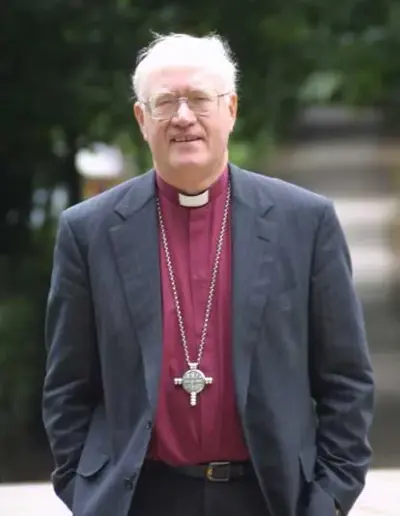
George Leonard Carey, Baron Carey of Clifton, PC is a retired Anglican bishop who was the Archbishop of Canterbury from 1991 to 2002, having previously been the Bishop of Bath and Wells.
