Amr Ibn Al-As Quotes
In the Name of God, the Merciful, the Compassionate. Here is the guarantee given by Amr ibn al-As to the inhabitants of Egypt for the safety of their persons, their religion, their goods, their churches, their crosses…The inhabitants of Egypt are required to pay a tax…If by the end of the annual flood the river has not reached the appointed height, the tax will be proportionately reduced.
Amr Ibn Al-As, *, Muslim conqueror of Egypt, Treaty of surrender, 644 BC
Sourced by: Eigen's Political and Historical Quotations

This problem which was so well described over a century ago in Egypt, still vexes most of the Islamic world.

This quotation illustrates that a narrow orthodox view of Islam is not the only one in Arab nations. Khaled is not an obscure cleric, but a popular television personality. While his views are considered heresy by many orthodox Muslims, the narrow view is by no means universal. Orthodox Islamists believe that God has commanded that all mankind be Muslims and the ones who are not are either ignorant so need to be “educated”, or evil and therefore should be killed. However, Muhammad ordained that an exception should be made for “Children of the Book”—Jews and Christians who revere the Old Testament. This was at a time when Christians would not allow any other form of worship but Christianity. Christianity, Judaism and most other religions have become tolerant of other religions and allow open alternative worship. Islam which early on led the way to tolerance, has in many countries gone back to the intolerance that existed amongst many Christians at the time of Muhammad.
In 2005 an Egyptian writer, Usama Anwar Ukasha, criticized one of the Prophet’s companion’s role for causing dissention and divisiveness in Islamic history. Some called for his legal punishment for slandering a holy figure (see {588714}) and a law case was brought to force him to divorce his wife—so that she would not be “contaminated by his heretical thoughts. Al-Bana argued for freedom of thought and speech on such subjects. His view was particularly important since he was the brother of Hassan Al-Bana, the founder of the Muslim Brotherhood, a powerful fundamentalist organization. Note that Al-Bana’s call for intellectual freedom does not go so far as to say that it should be legal to criticize The Prophet Muhammad and it illustrates how far even modern Islam has to go to meet reasonable standards of freedom of thought and speech.

In September of 2005 a Danish Newspaper published some political cartoons showing the hypocrisy of some Muslims who use Islam to justify murder of innocents and terrorism. Months later, many in the Middle East protested vehemently and Muslim riots broke out because the Prophet Muhammad's visage was depicted against Islamic tradition. Many Muslim leaders claimed that insulting religion was an “abuse” of freedom of speech including those from nations which regularly publish material that is virulent against Christians and Jews. That was particularly true of Egypt which commonly insulted Christianity and Judaism and the government always claimed that they could not interfere with private publications and broadcasts because Egypt had freedom of speech and the press.
She was originally Egyptian but because of her criticism, her citizenship was actually revoked.
See {617160} for a similar legal opinion. The concern was that poor Muslims may desert their faith when they see how well-dressed the tolerated people, Christians and Jews, are. They might conclude that Christianity or Judaism is better at making people wealthy than was Islam. See {617162} for a Koranic support of the idea. The Western view of this is generally, that is what the marketplace of ideas is all about. In 21st century America, Jews and Mormons on the average were the wealthiest religious groups. The logic of al-Ramli is that Mormons and Jews—each only 6 percent of the population—should not be allowed to show their wealth, lest Roman Catholics for example—25 percent of the population—will convert from Catholicism to the other two religions. From a democratic point of view, the response should be, we so be it. That is their choice. But America is the living proof that the assumption of conversion and loss of faith is per se wrong. The Mormons and Jews are visibly more successful, yet there are very few Roman Catholics leaving their church and converting to the two wealthier religions. There are some, but not at any greater rate than people convert from “wealthier” religions.


Islam was not very strong at this point and the followers of Muhammad were relatively few and the Medina area contained Arab Non-Believers, Jews as well as the new Muslims. Muhammad drew up this document and got the non Muslims to agree to it. Not only were Jews able to practice their religion freely (as were the non-Muslim Arabs) but there was not tax on the non Muslims that was imposed later when the Muslims were much stronger relative to others. Also, which surprises many Jews and Muslims alike, the Community – the Ulma – the People included the Jews and Arab Non Believers. Today it is only the Muslims.

He is a Greek Orthodox Christian, and he correctly observes that the Islamic world was considerably more tolerant than the Christian until the 18th century when Islam had become less tolerant in the Middle East while the Christians were modernizing and going through a cultural and intellectual enlightenment and societal modernization while the Muslims, became less tolerant than they were in earlier years leading to the modern situation.

Unlike other conquerors who wanted their wealth, property, animals or women, this was an offer that was almost too good to refuse even if the community were well fortified and had organized soldiers. It is important to note that these options were not available to all people. The Prophet had decided to allow Jews, Christians and Zoroastrians to practice their religion and pay the fizya tax which was not very high. The Persians were Zoroastrians and hence the did not have to convert which most other people did. The Muslim conquest of Persia, therefore, was much easier than most other places.

In the last centuries, Egypt has been intellectually more advanced than the other Arab countries. It has a significant number of modernists who oppose religious influences on Government. During the Arab Spring when the old regime was ousted, the modernists had hopes that a modern democracy would be formed that was not controlled of even significantly influences by religious leaders and where women would have equal rights. However, the first election the Muslim Brotherhood, a religious party won, and then tried to institute Islamic law—Sharia. A coup ousted the Muslim Brotherhood, and then many dreamed again of a modern, non-sexist, secular democracy. Professor Ajami tried to give them a more realistic view.


This was a remarkable public statement for its time. No other political leader of an Islamic country would dare claim that people have a right to be atheists. Very few would even suggest that people should be free to choose their own religion.


The re-conquest had just taken place where the Christians defeated the Islamic troops and the King found himself ruling extensive Muslim dominated areas like Toledo as well as large Christian areas. While atypical for a Christian Catholic King, Alfonso VI went out of his way to avoid a crisis with either religious group. He told the Muslims that they could follow Islamic practices and let it be known by statements like this that he had two religions in his kingdom.

Historically, this quotation shows that the negative relationship between the West and Islam and negative views of Islam was not a new phenomenon at the beginning of the 21st century. It existed long before, and as with the 21st century concerns, violence and war were the major concerns.

Many of the local muftis, mullahs, and imams told the Muslims that it was against the religion to use condoms or even publicly provide information about how AIDS is transmitted and how it may be prevented. They also opposed many of the immunology programs, believing that the vaccines interfered with God’s will and the fate that he ordained for people.

It is precisely for these reasons that large numbers of Muslims consider Ghannouchi and other reformers to be threats to Islam and in need of suppression in order to protect their religion.


In September of 2005 a Rose’s newspaper published some political cartoons showing the hypocrisy of some Muslims who use Islam to justify murder of innocents and terrorism. Months later, in January of 2006 many in the Middle East protested vehemently and Muslim riots broke out because the Prophet Muhammad's visage was depicted against Islamic tradition. Many Muslim nations started a boycott against Denmark. Many Muslim leaders claimed that insulting religion was an “abuse” of freedom of speech including those from nations which regularly publish material that is virulent against Christians and Jews. Apologies were demanded from Rose.

The Muslim Brotherhood had won the Presidency in the first Egyptian democratic election shortly after the ouster of Mubarak when they were the only party that was organized. However, after one year of government, their performance was so bad that critics like El Baradei offered strong public criticism—especially of the preoccupation with Islam with little government attention given to freedom, human rights, and the economy which was in terrible shape. This was the focus of the pointed article title. A few days after this article was published there was an insurrection of huge crowds of Egyptians and the Muslim Brotherhood President Morsi was forced to resign.
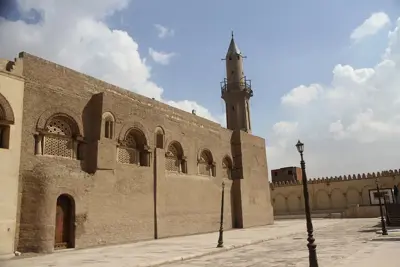
Amr ibn al-As al-Sahmi (Arabic: عَمْرِو بْنِ الْعَاصِ, romanized: ʿAmr ibn al-ʿĀṣ al-Sahmī; c. 573 – 664) was the Arab commander who led the Muslim conquest of Egypt and served as its governor in 640–646 and 658–664. The son of a wealthy Qurayshite, Amr embraced Islam in c. 629 and was assigned important roles in the nascent Muslim community by the Islamic prophet Muhammad. The first caliph Abu Bakr (r. 632–634) appointed Amr as a commander of the conquest of Syria. He conquered most of Palestine, to which he was appointed governor, and led the Arabs to decisive victories over the Byzantines at the battles of Ajnadayn and Yarmouk in 634 and 636.
