George Herbert Quotes
In great pedigrees there are Governours and Chandlers.
Herbert, George. Outlandish Proverbs, Selected by Mr. G. H. Printed by T. Paine for Humphrey Blunden, 1640.


Bodin was advocating the release of the Cambodian King.


Here we have a very mockery of the concept of aristocracy and “good family”. This humorous essay was written less than a decade after Darwin published his first treatise on evolution. Here a witty American essayist and critic is giving an insight into the thoughts of the many people who either were scandalized by the concept of human evolution or honestly could not grasp such a new intellectual set of concepts. Many of the great scientific intellectual breakthroughs spread with stunning rapidly—usually amongst scientists, but in the case of evolution to most intellectuals and men of letters, they could use Darwin’s framework and observe evidence of evolution all over. So here, less than 10 years from the inception of evolutionary theory among English scientist, we have American non-scientific literati reading articles in the general (albeit sophisticated) Atlantic Monthly with a semi-serious, semi-comical, analysis of the thinking of people who resisted what had become in just a few years obvious truth to America’s leading intellectuals (except for most of the leading intellectual theologians who would take longer to accept evolution, but, with the exception of the extreme fundamentalists, most did.


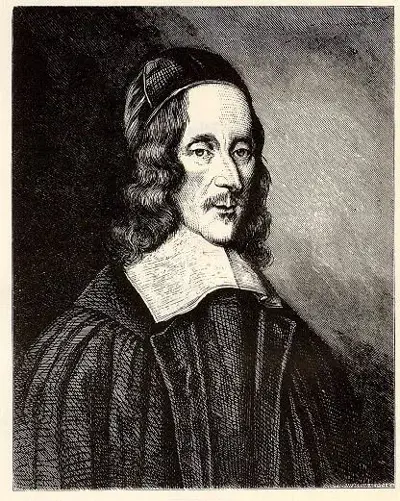
George Herbert was a Welsh-born poet, orator, and priest of the Church of England. His poetry is associated with the writings of the metaphysical poets, and he is recognised as "one of the foremost British devotional lyricists." He was born into an artistic and wealthy family and largely raised in England. He received a good education that led to his admission to Trinity College, Cambridge, in 1609. He went there with the intention of becoming a priest, but he became the University's Public Orator and attracted the attention of King James I. He served in the Parliament of England in 1624 and briefly in 1625.
