Noam Chomsky Quotes
In Egypt the neoliberal programs have meant statistical growth, like right before the Arab Spring, Egypt was a kind of poster child for the World Bank and the IMF [International Monetary Fund:] the marvelous economic management and great reform. The only problem was for most of the population it was a kind of like a blow in the solar plexus: wages going down, benefits being eliminated, subsidized food gone and meanwhile, high concentration of wealth and a huge amount of corruption.
Chomsky, Noam. Power Systems: Conversations on Global Democratic Uprisings and the New Challenges to U.S. Empire. Interviews with David Barsamian, Metropolitan Books, 2013.


Under the Community Action Program, community groups were founded throughout the country. Some of these then tried to unseat the incumbent governors, mayors and city councilmen. Soon Governors were given veto powers on grants within their states.


The Organization for Economic Cooperation and Development (OECD) had proposed International Development Goal Benchmarks for donor organizations which was then officially endorsed by the World Bank, the IMF and the UN. But many people thought that many of these “benchmarks” were not only invalid but exacerbated some of the problems that they were trying to fix—especially in a developing country where structural factors inhibited class mobility and the focus was on large businesses and not small and “mom & pop” enterprises that poor could aspire to and benefit from.

See {34743} or {33971} for a more colorful and eloquent statement of the same notion.


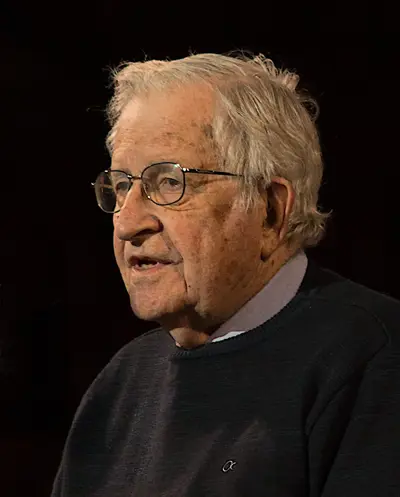
Avram Noam Chomsky is an American linguist, philosopher, cognitive scientist, historian, social critic, and political activist. Sometimes called "the father of modern linguistics", Chomsky is also a major figure in analytic philosophy and one of the founders of the field of cognitive science. He is Laureate Professor of Linguistics at the University of Arizona and Institute Professor Emeritus at the Massachusetts Institute of Technology (MIT), and is the author of more than 150 books on topics such as linguistics, war, politics, and mass media. Ideologically, he aligns with anarcho-syndicalism and libertarian socialism.
