Baruch Spinoza Quotes
If you find the light of Scripture clearer than the light of reason (which also is given us by divine wisdom), you are doubtless right in your own conscience in making your reason yield. For my part, since I plainly confess that I do not understand the Scriptures, though I have spent many years upon them, and since I know that when once I have a firm proof I cannot by any course of thought come to doubt of it, I rest wholly upon that which my understanding commends to me, without any suspicion that I am deceived therein, or that the Scriptures, even though I do not search them, can speak against it. For one truth cannot conflict with another.
Benedict Spinoza, Letter to Hugo Boxel. 1674
Sourced by: Eigen's Political and Historical Quotations

Al-Maarri’s quotations are not only meaningful in their own right, but they illustrate the openness and free thinking that was allowed in the early days of Islam before about 1100. If anyone wrote such things today in most Islamic countries he would at least be jailed if not executed for blasphemy. And if any Christian in Europe made the same statement, he would have been excommunicated at least if not tortured and murdered.


This view was infuriating to the Rabbis, Priests and Immams of the time. Miracles and Scrip[ture were not determinatve Spinoza taught but the issue was did the docrine of the religion make sense. Spinoza’s ideas were considered so radical and dangerous that he was the only man in history who was excommunicated by the Catholics, the Jews and the Muslims.


Although a conservative, he had a great tolerance for and understanding of other points of view. For this some people thought him a radical.


Elijah Ben Solomon -- Vilna Gaon. The Torah is the first 5 books of the Old Testament which the Jewish People regard as the basis of religion. For many, the interpretation is that of many Fundamentalist Christians and Jews that the Bible contains truth and all truth. However, there were those who have claimed that in addition to the words and their meaning, there is a code in the Bible that gives prophetic information, claiming that all major subsequent historical events were predicted in the Biblical code.


3rd Earl Russell of Kingston


Spinoza’s ideas were considered so radical and dangerous that he was the only man in history who was excommunicated by the Catholics, the Jews and the Muslims.

Franklin was a deist. He believed in God and the Creation but not the Bible which is often referred to as “revealed” truth. He did believe that classic Christianity was a positive force as some people were led to good works and a moral life by it.

The Creation Museum makes the Christian Fundamentalist Case for their alternative view of the creation of the earth and man. In the process, they make claims that are proven incorrect every day in science, like the earth is only about 6000 years old {641849} , and all the species on earth were then separately created in their immutable form with no evolutionary process. There are many deeply religious Christians who do not take the Bible literally and have no problem with evolution as the mechanism which God selected to create and develop life. The Roman Catholic Church, for example, does not maintain that the Bible is literally true and Evolution did not account for the development of life on earth. The major difference between most modern scientists, philosophers, and theologians, is that some believe that God of other Supreme Being had nothing to do with the evolution and development of life forms and those who believe that Evolution was the mechanism that God created and used. See {641848} for an example of the former.
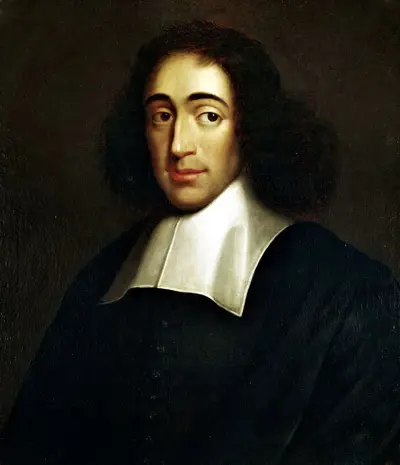
Baruch (de) Spinoza was a Dutch philosopher of Portuguese Sephardi origin. One of the early thinkers of the Enlightenment and modern biblical criticism, including modern conceptions of the self and the universe, he came to be considered one of the great rationalists of 17th-century philosophy. Inspired by the groundbreaking ideas of René Descartes, Spinoza became a leading philosophical figure of the Dutch Golden Age. Spinoza's given name, which means "Blessed", varies among different languages. In the Netherlands he used the Portuguese name Bento. In his Latin and Dutch works, he used Latin: Benedictus de Spinoza.
