Atal Bihari Vajpayee Quotes
If you do not like anything in a particular book, then sit and discuss it. Banning a book is not a solution. We have to tackle it ideologically.
Vajpayee, Atal Bihari. Selected Speeches of Prime Minister Atal Bihari Vajpayee, vol. 2, Publications Division, Ministry of Information and Broadcasting, Govt. of India, 2000, p. 194.


In 2005 an Egyptian writer, Usama Anwar Ukasha, criticized one of the Prophet’s companion’s role for causing dissention and divisiveness in Islamic history. Some called for his legal punishment for slandering a holy figure (see {588714}) and a law case was brought to force him to divorce his wife—so that she would not be “contaminated by his heretical thoughts. Al-Bana argued for freedom of thought and speech on such subjects. His view was particularly important since he was the brother of Hassan Al-Bana, the founder of the Muslim Brotherhood, a powerful fundamentalist organization. Note that Al-Bana’s call for intellectual freedom does not go so far as to say that it should be legal to criticize The Prophet Muhammad and it illustrates how far even modern Islam has to go to meet reasonable standards of freedom of thought and speech.


This became a critically important quotation a half century after it was made. Judge Hand articulated the majority Western and Judeo-Christian value proposition between dissent and heresy. However, for the majority of the Islamic world, the reverse represents the majority value that is held. There is a minority in the West that agrees that avoidance of heresy is paramount and a minority of the Muslim world that agrees that the protection of dissent is the more important value, but the two civilizations were at odds in the 20th and 21st centuries. However, Islam is about 600 years younger than Christianity. 600 years ago, the Christian world agreed with the Muslim society and prevention of heresy was the more important value. The Reformation and the enlightenment followed by the world example of America produced a transformation and this may occur in the majority of the Islamic world in time.

She was dealing with a serious campus situation where an invited speaker, Chief of Police Kelly of New York City was prevented from giving his p resentation on the controversial “Stop and Frisk” rules by student protesters who opposed the practice. Brown’s tradition of hearing anyone on the campus regardless of point of view had been broken to the distress of most students, faculty and alumni.


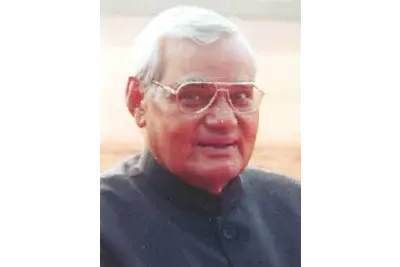
Atal Bihari Vajpayee was an Indian statesman who served three terms as the Prime Minister of India, first for a term of 13 days in 1996, then for a period of 13 months from 1998 to 1999, followed by a full term from 1999 to 2004. Vajpayee was one of the co-founders and a senior leader of the Bharatiya Janata Party (BJP). He was a member of the Rashtriya Swayamsevak Sangh, a Hindu nationalist volunteer organisation. He was the first Indian prime minister not of the Indian National Congress to serve a full term in office. He was also noted as a poet and a writer.
