Antonin Scalia Quotes
If you condemn someone who has committed a crime to be tortured, that would be unconstitutional.
Scalia, Antonin. Interview by Law in Action. BBC Radio 4, 12 Feb. 2008.


The capital punishment debate was raging in Europe. Belgium and parts of Switzerland had just abolished the death penalty.

Major Fleener had been assigned to defend accused terrorists who were being held at the military prison in Guantanamo, Cuba. For several years they were held without a hearing or trial. Then the U. S. Supreme Court ruled that they had to be given a hearing or trial. A Military tribunal was selected. The methods and procedures of these hearings came under much public world-wide criticism as they did not meet the normal legal standards of most countries. Surprisingly, one of the military officers made public statements criticizing the army and the trials.


The choice is usually contrasted between guilty persons going free, rather an innocent one be adjudicated guilty. But here the justice tells us that the avoidance of an innocent person being subject to easy arrest is important enough to have a system where guilty people sometimes escape justice.


As a Federal Judge, she was obligated to sentence people guilty of certain crimes to a minimum sentence prescribed by law and a sentencing commission.

See {642427} for a case where the United States was accused of not living up to this treaty.


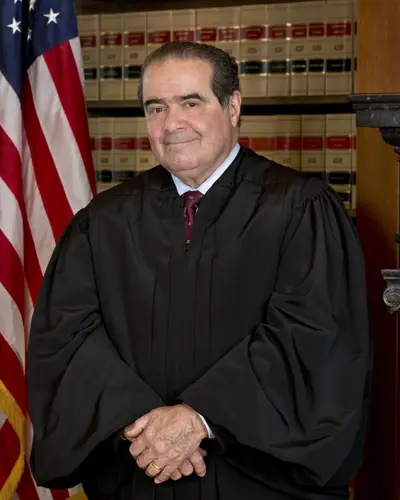
Antonin Gregory Scalia was an American jurist who served as an associate justice of the Supreme Court of the United States from 1986 until his death in 2016. He was described as the intellectual anchor for the originalist and textualist position in the Court's conservative wing. For catalyzing an originalist and textualist movement in American law, he has been described as one of the most influential jurists of the twentieth century, and one of the most important justices in the Supreme Court's history. Scalia was posthumously awarded the Presidential Medal of Freedom in 2018 by President Donald Trump, and the Antonin Scalia Law School at George Mason University was named in his honor.
