Muhammad Quotes
If they … attack your religion with disapproval and criticism, then fight the leaders of disbelief …
This quotation is used by some Islamic fundamentalists to justify attacks on people who criticize or disapprove of Islam. They see this as an instruction from the Prophet. The same quotation is used by critics of fundamentalist interpretations to show that literal interpretations eliminate any kind of criticism and provides no freedom of speech.
Muhammad, 571-632, Prophet and Founder of Islam, Koran, Sura 9:12
Sourced by: Eigen's Political and Historical Quotations

Toleration is a relative term. The Muslim Moors made Christians (and Jews) pay a special tax. At times they were forced to wear special clothing so that they could be readily identified. And they could not build churches larger or taller than the smallest mosque in the community. At times, their occupations were restricted but at other times Christians and Jews were appointed to the highest positions like Vizier. The Inquisition, in contrast, forced all Muslims (and Jews) to leave the country without any of their property or money or be tortured and killed—usually by burning at the stake unless of course that they converted to Christianity.

In the early stages of Islam, Muhammad had hoped to convert the Jews and others on the Arabian Peninsula. When they refused to be converted, he warred against them usually killing the men, and taking the women and children as slaves. The result was that non-believing tribes were “cleansed” from the Arabian Peninsula. The Muslims at the time preferred children as slaves. For then they could convert the children against their will. Adults in Islam must accept Islam in order to convert. Children are regarded as having no such maturity of decision making and therefore opposition to conversion may be ignored and they may be forced. Critics of Islam and those who argue that Islam is at odds with all other religions point to this quotation. They claim that it is the only religion whose founder and fundamental scriptures demand war against others for no other reason than that they believe in a different religion. The Catholic Church during the Crusades and the Inquisition had a similar philosophy as did Christian missionaries colonizing Africa later. One difference is that most Christians today repudiate the doctrine as against the true spirit and teachings of Christ and view it as historical error, while very few modern Muslims repudiate this quotation of the Prophet.
It is this verse that for some Muslims justifies terrorism against non-Muslims. See {584354} for a specific example. There are similar provisions in the Old Testament which a few extremely conservative Jews and Christians have used to advocate for blasphemy being a capital crime. Note that if an unbeliever repents and becomes a Muslim, he should be spared.
This sura has unfortunately been used by some Serbians and other Christians to justify ethnic cleansing against Muslims.

Rushdie was commenting on the Danish Cartoons that had been published the year before depicting the Islamic Prophet Muhammad to the great distress of some fundamentalist Muslims some of whom orchestrated riots in many countries involving much property destruction and some loss of life. See {590918} as an example of the concern.

Just days before September 11. While in America, such a remark would just be considered an insensitive and inappropriate utterance, in France, he was brought before the courts and threatened with jail and a large monetary fine under a 1972 French law which bans hate speech. See {595311}
Despite the fact that the statues were holy symbols to Buddhists, they were offensive to Muslims who say statues as “graven images” prohibited by the Koran. See Wakil Ahmad Muttawakil {608419} and Jamal’s other quotation {604665}.


These kinds of inflammatory sermons are delivered with the approval of the king and royal family who crack down on any cleric who preaches what they do not approve of.


This quotation demonstrates that religious persecution of non Muslims was a duty, This has been a characteristic of all religious persecution regardless of religion. The quotation also shows that after 600 years, the original limited tolerance the Prophet had urged for People of the Book (Jews and Christians) was waning. Instead of non-believers being tolerated if they paid the special tax and were second class citizens, leaders were urged to convert or eliminate “infidels.”

He is a Greek Orthodox Christian, and he correctly observes that the Islamic world was considerably more tolerant than the Christian until the 18th century when Islam had become less tolerant in the Middle East while the Christians were modernizing and going through a cultural and intellectual enlightenment and societal modernization while the Muslims, became less tolerant than they were in earlier years leading to the modern situation.
Damn this world, Damn this time. Damn this fate That uncivilized Arabs have come to make me a Moslem
This is a huge epic poem that he wrote over several years. At the time, the Persians considered themselves far more civilized and sophisticated than the Arabs who were but tribesmen. They really resented the fact that it was the Arabs that brought Islam. And before, most of the Persians worshipped Zoroaster. Although Islam spread faster and further than any religion in history, it was not always easily accepted as this stanza of the poem indicates. There is to this day a superiority that the Iranians perceive over the Arabs. And to this day, many Arabs resent the Iranians for this attitude.
The reason he claimed that Governor Taseer was a blasphemer was that the governor opposed death penalty for saying or writing anything that was heresy or blasphemy as interpreted be fundamentalist Muslims. The Governor knew he was taking a risk. See {620970} .

This is a typical law in most modern Muslim countries. Essentially, Muslim Sharia Law prohibits any insult to the Prophet, the Koran and other sayings of the Prophet. This law of course, violates the UN Declaration of Human rights and freedom oriented counties tend to deride the restrictions of freedom of speech and expression. However, to show that the Muslim nation is being “fair”, laws like this one supposedly “protect” people of other religions from the wounding of religious feelings when their religion is slandered. Christians and other non-Muslims are prosecuted commonly. At the same time, ultra-fundamentalist Muslim clerics and teachers at religious schools commonly preach hate and desecration of Christianity, Judiasm, and Hinduism commonly. None are ever prosecuted.

Bashir advocates adapting Sharia—Islamic Law—for all people in Indonesia—regardless of their religion or their preference for separation of church and state. This is diametrically opposite to an Islamic Syrian poet of 1000 years ago—see {624477}. Many Muslims have become more intolerant than some of their earlier scholars. Bashir also differs from most Indonesian Muslims who have historically not shared his bigotry and intolerance.

In one of the historical ironies of the 12th century, a Christian sect preferred the rule of the Muslims than their Christian brethren—on the grounds of religious tolerance. It illustrates the changes that take place over time. By the 21st century, it was the Christians who were thought of as tolerant and the Muslims as the opposite.

Nigeria was about equally divided into Muslims who dominated the North and Christians and Animists who dominated the South. The former were intent on making Sharia—Islamic Law—the law of the nation and the latter were equally passionate to avoid it. Muslim protests got very violent including murdering innocent civilians; the Christians threatened to retaliate.

In the middle of 2010, this organization was running public utility bus ads in major American cities.
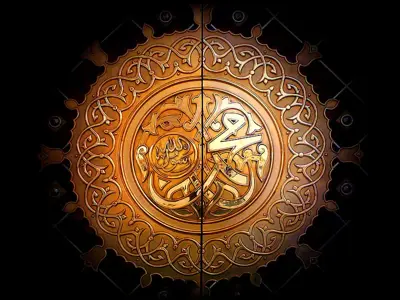
Muhammad was an Arab religious, social, and political leader and the founder of Islam. According to Islamic doctrine, he was a prophet, sent to preach and confirm the monotheistic teachings of Adam, Abraham, Moses, Jesus, and other prophets. He is believed to be the final prophet of God in all the main branches of Islam, though some modern denominations diverge from this belief. Muhammad united Arabia into a single Muslim polity, with the Quran as well as his teachings and practices forming the basis of Islamic religious belief.
